(888) 737-7690

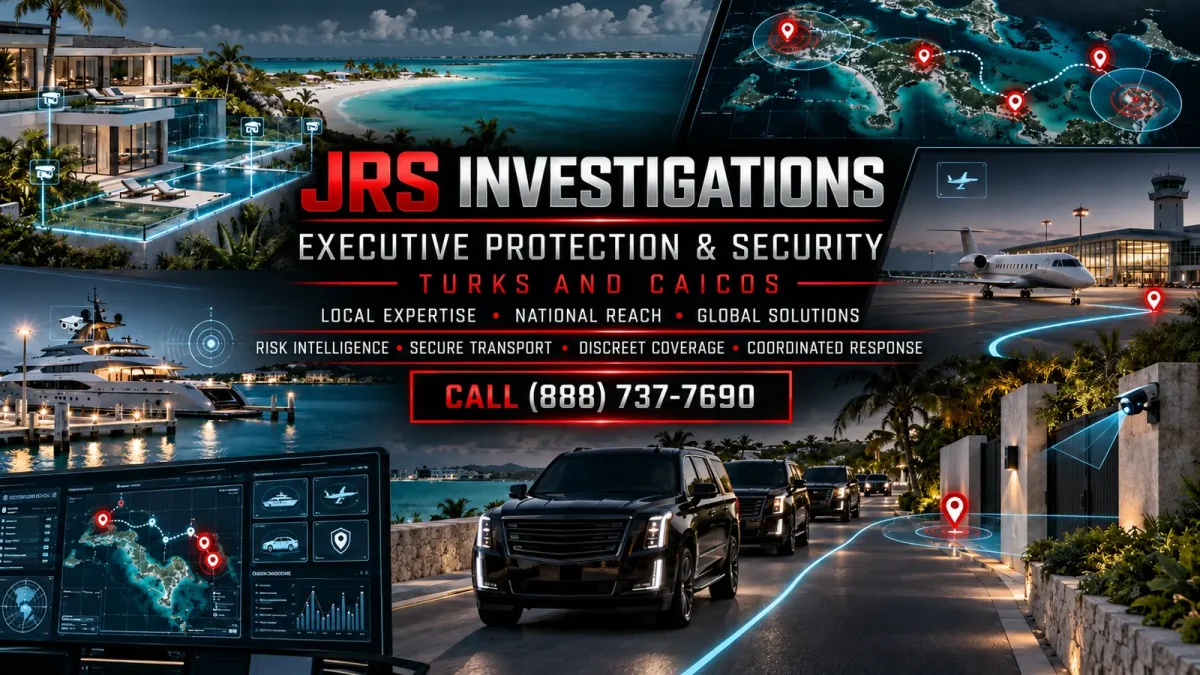
4 Benefits of Private Security in Turks and Caicos
Travel, business, special events, villa stays, and high-profile itineraries can create security concerns that are difficult to manage without advance planning. In Turks and Caicos, private security support can help clients assess exposure, coordinate movements, and respond more effectively when circumstances change. The right service is not simply a visible guard; it is a plan built around the client, locations, schedule, and lawful objective.
JRS Investigations assists clients seeking Turks and Caicos private security and executive-protection support. Services must always be arranged and performed in accordance with applicable local law, licensing requirements, property rules, and the authority of local agencies. Availability and scope depend on the circumstances, so an early confidential consultation is important.
1. Proactive risk assessment and planning
One of the greatest benefits of professional security is the ability to identify foreseeable problems before they disrupt a trip, meeting, event, or daily routine. A security assessment may consider arrival and departure points, accommodations, transportation, venue access, public exposure, medical needs, communication plans, known disputes, and any credible threats reported by the client.
This does not mean every risk can be predicted or eliminated. It means the team can prioritize realistic concerns and prepare proportionate responses. For example, planning may address alternate routes, secure meeting areas, controlled access to a private villa, procedures for unexpected visitors, or a reliable point of contact when the itinerary changes.
Clients should provide accurate information about schedules, locations, participants, previous incidents, and special needs. The quality of the plan depends on the information available and the time allowed for preparation.
2. A discreet professional presence
Many clients want protection without attracting unnecessary attention. Executive protection can often be delivered with a low-profile approach suited to a resort, private residence, business meeting, family activity, or social event. The objective is to support the client’s movement and privacy while avoiding needless disruption.
A discreet presence may help deter opportunistic interference, discourage unauthorized access, and provide an informed observer who is focused on the surroundings. It can also reduce the burden placed on family members, assistants, hosts, or employees who are not trained or assigned to manage security concerns.
Security personnel cannot guarantee that an incident will not occur, and visibility alone is not a complete plan. Professionalism, communication, judgment, and a clearly defined role are more valuable than an intimidating appearance.
3. Coordinated response when circumstances change
Travel conditions can change quickly. A delayed flight, altered venue, transportation problem, unexpected crowd, lost communication, medical concern, or unplanned guest can affect an otherwise routine schedule. A prepared security plan establishes responsibilities and communication channels before pressure increases.
Depending on the agreed scope, support may include coordination with drivers, property managers, event personnel, hotel or villa staff, local service providers, and appropriate authorities. In an emergency, local police, fire, medical, coast guard, and other public agencies remain the proper responders. Private security supplements those resources; it does not replace them or assume government authority.
Clear escalation procedures help the client and team understand when to pause movement, change locations, request assistance, preserve information, or contact emergency services. This structure can improve decision-making even when an event falls outside the original plan.
4. Protection tailored to the client and itinerary
No two assignments are identical. A business executive attending confidential meetings has different concerns from a family staying at a private villa, a public figure appearing at an event, or guests moving between an airport, marina, resort, and off-site activities. Effective security should reflect those differences.
Subject to availability, local law, and the agreed scope, planning may address:
- Executive or close-protection support for business and personal travel.
- Airport, ground-transportation, arrival, and departure coordination.
- Residential or villa access awareness during a scheduled stay.
- Security planning for meetings, events, private functions, and public appearances.
- Family itinerary support and coordination among multiple participants.
- Low-profile movement when the client wants to minimize attention.
- Communication, contingency, and emergency-contact procedures.
Some requests may require separately licensed local providers or additional specialists. A responsible security planner should explain who will perform each function, what authority they have, and which services are outside the assignment.

When should you consider private security?
Private security may be appropriate when a client has a known or credible concern, significant public visibility, valuable assets, a sensitive business purpose, a complex itinerary, or a need for professional coordination. It can also be useful when a family, company, or event organizer wants a structured plan instead of assigning security responsibilities informally.
Relevant circumstances may include:
- Previous unwanted contact, threats, stalking, harassment, or a contentious dispute.
- Public appearances, media attention, or easily identified travel plans.
- Confidential negotiations, executive meetings, or valuable business information.
- Large private events, multiple locations, or frequent itinerary changes.
- Travel involving children, elderly participants, medical needs, or separate family movements.
- Concern about unauthorized access to a residence, villa, yacht, vehicle, or event area.
A feeling of unease is not proof of a specific threat. The consultation should distinguish documented concerns from assumptions and recommend a response that is reasonable for the risk.
Questions to ask before retaining a security provider
Clients should understand the proposed scope before work begins. Ask who will supervise the assignment, whether any local licenses or permissions are required, how information will be protected, what communication methods will be used, and how emergencies will be handled. Confirm transportation responsibilities, working hours, excluded services, and procedures for schedule changes.
It is also important to discuss privacy. The security team may learn sensitive details about the client’s family, business, accommodations, and movements. Information should be limited to those who need it for the assignment and handled according to the engagement terms and applicable law.
Frequently asked questions
Is private security the same as law enforcement?
No. Private security personnel do not replace police or other public authorities. Their duties and legal authority depend on local law, licensing, contract terms, and the agreed assignment.
Can protection be provided without drawing attention?
Often, yes. A lower-profile posture may be appropriate for resorts, meetings, family activities, and private events. The level of visibility should be selected according to the risk and environment.
Can a security team guarantee safety?
No responsible provider can guarantee that every threat or incident will be prevented. Professional planning can reduce exposure, improve awareness, and support a coordinated response, but risk cannot be eliminated completely.
How early should arrangements begin?
As early as practical. Advance notice allows time to review the itinerary, confirm local requirements, coordinate personnel and transportation, and develop contingency plans. Urgent requests may be possible, but options can be more limited.
Discuss private security in Turks and Caicos
Learn more about private security and executive-protection services in Turks and Caicos. Clients with investigative needs can also review our Turks and Caicos private-investigator services.
To discuss an upcoming trip, event, residence, or security concern, contact JRS Investigations or call (888) 737-7690. Knowledge is power.