(888) 737-7690

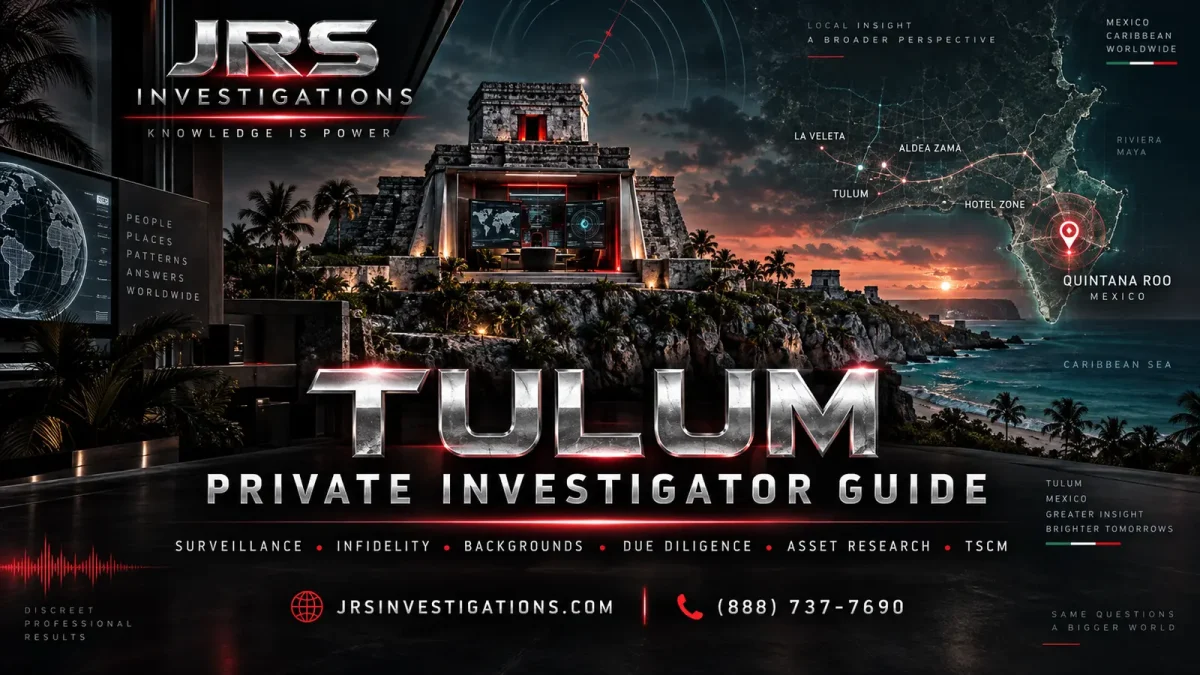
How to Hire a Private Investigator in Tulum, Mexico
Hiring a private investigator in Tulum is not the same as hiring one in your home city. The assignment may cross borders, involve a resort or gated condominium, depend on narrow travel windows, and require coordination between the client, counsel, and investigators working on the ground. A useful investigation begins with a clear objective and a plan that respects privacy, property, and local law.
This guide explains how to evaluate a private investigator in Tulum, Mexico, what services may be appropriate, how the local environment affects fieldwork, and what a professional report should contain. It is a hiring and planning guide—not a promise that any particular method, fact, or result will be available in every case.
For a confidential case assessment, contact JRS Investigations in Tulum or call (888) 737-7690.
When a Tulum Private Investigator May Be Useful
Clients contact investigators for many reasons, but the best assignments start with a specific question. “Find out everything” is too broad. “Document whether a subject meets an unidentified person during a scheduled Tulum trip” or “verify who controls a property and whether the business representations can be corroborated” gives the investigator something lawful and measurable to plan.
Infidelity and relationship investigations
Tulum’s resorts, private villas, beach clubs, and nightlife can create both concern and confusion for a partner at home. Surveillance may help document observable conduct in places where the subject has no reasonable expectation of privacy. It does not authorize entry into a hotel room, private residence, restricted resort area, or protected device or account. If your concern is specifically relationship-related, read our separate guide to possible signs of infidelity in Tulum before deciding whether fieldwork is warranted.
Background and due-diligence inquiries
A background or due-diligence assignment may examine identities, business affiliations, litigation or public-record leads, property representations, professional history, and inconsistencies in information supplied by a person or company. Cross-border research requires care: names may appear in different formats, records may be fragmented, and a database result is only a lead until it is corroborated. A responsible investigator explains which sources were checked, what could not be verified, and where additional legal process may be necessary.
Fraud, asset, and business investigations
Investors, property owners, attorneys, and businesses may need help tracing representations, locating public asset indicators, documenting activity, or identifying people connected to a disputed transaction. Investigators can develop leads from lawful records, interviews, site observations, and open-source research. They cannot guarantee recovery, seize property, access bank records without authority, or substitute for Mexican or U.S. legal counsel.
Missing-person and witness-location work
Location assignments may involve a traveler who has stopped communicating, a witness connected to litigation, a family member, or a person whose current address is uncertain. Urgent welfare concerns should also be reported to appropriate authorities and consular resources. For an American citizen missing abroad, the U.S. Department of State provides a dedicated emergency pathway; a private investigation can support fact development but does not replace official response.
Authorized TSCM and privacy-security reviews
A technical surveillance countermeasures inspection may be appropriate when a client controls the property or has documented authority from the owner. A professional TSCM bug sweep can assess radio-frequency activity, physical spaces, wiring, network indicators, and suspicious devices. It is not permission to inspect someone else’s room, vehicle, telephone, or computer. Scope and written authorization should be resolved before equipment is deployed.
Why Tulum Requires Local Operational Planning
Tulum is not one compact setting. An assignment can move among Tulum Pueblo, Aldea Zama, La Veleta, the Hotel Zone, beach clubs, private villas, construction sites, cenote routes, and destinations along the Riviera Maya. Travel time that looks short on a map may change with congestion, weather, road work, checkpoints, parking limitations, or controlled access.
Resorts, rentals, and gated properties
Hotels, condominiums, villas, and gated developments set their own access rules. A guest list, wristband, parking credential, reservation, or host approval may be required. Ethical investigators do not impersonate law enforcement, force entry, misuse a room key, or create a false emergency. When access is unavailable, the plan should shift to lawful observation points, arrival and departure patterns, interviews, or other corroboration.
Transportation and timing
A subject may use a rental vehicle, private transfer, taxi, scooter, bicycle, or multiple modes during one day. Investigators need enough time to establish position without drawing attention or driving unsafely. The client should provide known schedules, photographs, vehicle details, lodging information, companion names, and likely destinations as early as possible. Late changes may require additional personnel or a revised objective.
Safety and current travel conditions
Operational plans should account for current conditions, not assumptions from a previous visit. The U.S. Department of State’s Mexico Travel Advisory currently places Quintana Roo at Level 2, “Exercise Increased Caution,” and advises attention to surroundings after dark. That guidance is a planning input, not a prediction about a particular case. Investigators should use appropriate transportation, communication, check-in, and contingency procedures.
Assignments extending north toward Playa del Carmen or Cancun may need a broader staffing and travel plan. Our Riviera Maya investigation planning guide explains how a multi-location itinerary can affect coverage.
How to Evaluate a Private Investigator in Tulum
Ask who will actually perform the fieldwork
A polished website does not tell you who will be on the ground. Ask whether the case manager is also the field investigator, whether appropriately authorized local resources will be used, how many investigators are planned, and who reviews the final report. JRS evaluates each assignment individually and coordinates lawful resources suitable for the location and objective; we do not describe every Tulum matter as identical or rely on a blanket claim that one credential resolves every jurisdictional issue.
Demand a lawful, written scope
The investigator should be able to describe the objective, anticipated methods, exclusions, expected schedule, billing structure, communication protocol, and deliverables. The plan should also identify known constraints. If a proposed method depends on trespass, hacking, unauthorized tracking, access to protected records, covert entry, or obtaining private communications without authority, stop and obtain legal advice.
Review fees without chasing the lowest number
Cross-border cases may include investigator time, travel time, mileage, lodging, local transportation, equipment, research expenses, report preparation, and coordination. Ask what is included, what requires advance approval, whether there is a minimum block of time, and how unused funds are handled. A vague low estimate can become expensive when the actual itinerary, staffing, or access conditions emerge.
Look for measured language
Professional investigators explain possibilities and limitations. They do not guarantee infidelity proof, a hidden-device discovery, a favorable court outcome, or recovery of money. They also do not manufacture urgency by claiming that every change in behavior proves wrongdoing. A sound investigator protects the integrity of the case even when the findings do not support the client’s original suspicion.
Confirm reporting and confidentiality practices
Ask how notes, photographs, video, research results, and client communications are stored and transmitted. Determine who receives updates and whether counsel should be the primary contact. If the matter may lead to litigation, counsel can help define relevance, privilege considerations, preservation needs, and any required local legal review before the investigation begins.
What a Professional Investigation Plan Should Include
A practical plan connects the client’s question to lawful methods and realistic deliverables. It should include:
- A defined objective: the fact or behavior the assignment is intended to document or verify.
- Subject identifiers: current photographs, full names, aliases, vehicle details, social profiles, schedules, and known associates.
- Locations and access: lodging, property type, entry restrictions, reservation details, transportation, and probable destinations.
- Coverage window: dates, times, priority periods, and the trigger for extending or ending work.
- Methods: surveillance, interviews, lawful records research, open-source review, site verification, or authorized technical inspection.
- Communication rules: who may authorize changes, how urgent updates are handled, and how sensitive information will be shared.
- Deliverables: chronology, written report, photographs, video clips, source notes, limitations, and follow-up recommendations.
For physical observation assignments, see our overview of professional surveillance investigations. Good surveillance is not simply “following someone.” It involves advance research, lawful positioning, safe mobile coverage, contemporaneous notes, time-stamped media, and disciplined decisions about when not to pursue.
Evidence, Reports, and Cross-Border Use
An investigator should preserve original files, maintain accurate notes, distinguish direct observations from third-party statements, and explain research sources. A report should be factual and neutral. It should not turn assumptions into conclusions or omit inconvenient findings.
Whether information is admissible, discoverable, privileged, or useful in a particular court or administrative proceeding is a legal question. Requirements may differ between Mexico, a U.S. state, and another country. If litigation is anticipated, involve qualified counsel early enough to shape the scope and determine what authentication, declarations, testimony, translation, or local process may be needed.
Clients should also understand that an inconclusive result is not a failed investigation. Weather, access restrictions, itinerary changes, misidentification risk, or a subject remaining inside a private location may limit what can be observed. A credible report states those limits plainly.
Methods a Reputable Investigator Should Refuse
Pressure to “just get the answer” can create legal, ethical, and strategic problems. A reputable investigator should refuse requests to:
- hack email, messaging, cloud, financial, or social-media accounts;
- install a tracker or monitoring software without lawful authority;
- enter a room, residence, vehicle, or restricted property without permission;
- obtain protected hotel, medical, banking, telephone, or travel records through deception;
- record private communications where the method is prohibited;
- impersonate police, immigration, court personnel, or another protected identity;
- threaten, harass, bribe, or recklessly confront the subject; or
- alter, stage, or misrepresent evidence.
Legal boundaries depend on the facts, location, ownership, consent, and intended use. This guide is general information, not legal advice. JRS may recommend consultation with qualified counsel before accepting or continuing a sensitive assignment.
Frequently Asked Questions
Can JRS guarantee a result in Tulum?
No. JRS can design and execute a professional plan, but no investigator can truthfully guarantee what a subject will do, what records will exist, whether access will be available, or how a court will treat the findings.
How much does a Tulum private investigation cost?
Cost depends on the objective, dates, daily coverage, number of investigators, transportation, research, equipment, and reporting. After a confidential intake, JRS can explain the anticipated scope, retainer, and approval process for added work or expenses.
How much advance notice is needed?
More notice generally improves planning, especially during busy travel periods or when the subject’s schedule covers multiple locations. Urgent matters may still be possible, but staffing, access, and travel arrangements can affect availability.
Can an investigator enter a hotel room or private villa?
Not merely because a client requests it. Entry requires lawful authority and appropriate permission. Surveillance and documentation must respect private spaces, property rules, and applicable law.
Will I receive photographs or video?
When lawful, safe, and relevant, a report may include time-stamped photographs or video. Image quality and availability depend on distance, lighting, obstructions, access, weather, and the subject’s movements. The written chronology remains important because media rarely explains the entire sequence by itself.
Start With a Confidential Tulum Case Assessment
The strongest Tulum investigations begin before the first field hour. Gather the known schedule, recent photographs, property and transportation details, relevant communications, and the exact questions you need answered. JRS will assess the objective, identify constraints, and explain a lawful plan with realistic reporting expectations.
Call JRS Investigations at (888) 737-7690 or visit our Tulum private investigator service page to request a confidential consultation.