(888) 737-7690
Private Investigator Red Flags: 12 Warning Signs Before You Hire
Choosing a private investigator should begin with verification, not a promise. The wrong provider can waste a retainer, expose sensitive information, use methods that create legal problems, or produce a report that does not answer the client’s real question. The most important private investigator red flags often appear before work begins—in the license explanation, written scope, fee structure, proposed methods, communication plan, and claims about results.
This guide is intentionally different from our eight questions to ask before hiring a private investigator. That companion article explains what to ask. Here, we focus on the warning signs that should make a client pause, verify the provider, or seek another opinion.
Why private investigator red flags matter
Private investigations may involve family disputes, surveillance, background research, fraud, missing persons, corporate concerns, technical surveillance countermeasures, or litigation support. Each assignment can affect privacy, safety, cost, and important personal or business decisions. A professional investigator should therefore be willing to define the objective, explain lawful limits, identify who will perform the work, and describe how findings will be documented.
Licensing and authority depend on where the work occurs and what activity is performed. Florida clients can verify individual credentials through the official FDACS individual license search and agency credentials through the official FDACS agency search. North Carolina clients can review the official Private Protective Services Board. For work in another state, territory, or country, ask which authority applies and whether appropriately qualified local resources are required.
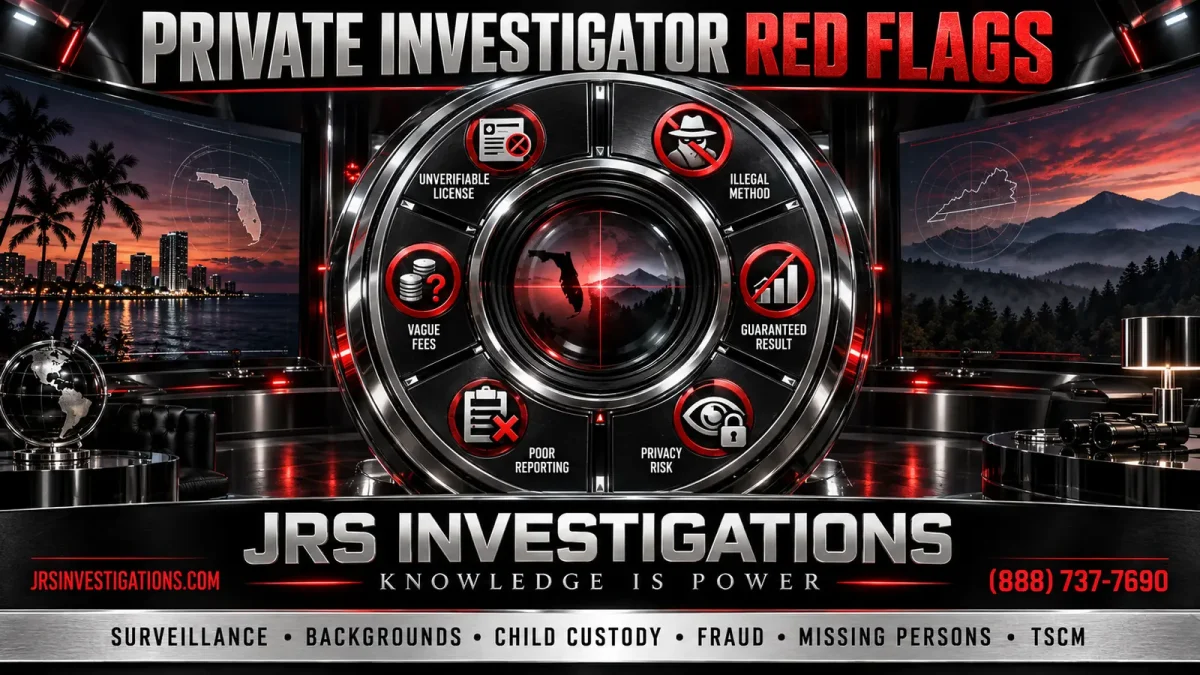
12 warning signs before you hire a private investigator
1. The provider will not identify the licensed agency or responsible investigator
A website name, social profile, business card, or database subscription does not establish investigative authority. Ask for the exact contracting entity, responsible investigator, license number when applicable, and jurisdiction. The name on the agreement and invoice should make sense when compared with official records. A provider who avoids these basic questions creates unnecessary risk before the case even starts.
2. The investigator claims to be licensed or authorized everywhere
No single credential creates universal authority. Licensing rules, privacy laws, recording laws, tracking restrictions, access rules, and investigative standards vary by location. Cross-border assignments may require local coordination, counsel, translation, or a narrower scope. Be cautious when someone says location does not matter or implies that a U.S. license automatically authorizes fieldwork anywhere in the Caribbean or abroad.
3. You are promised a specific discovery, court result, or guaranteed admissibility
An ethical investigator can promise a disciplined process, accurate reporting, and honest communication. The investigator cannot responsibly promise that surveillance will prove infidelity, an asset search will locate recoverable property, a missing person will be found, a sweep will identify every threat, or a court will admit or accept particular evidence. Results depend on facts, access, timing, law, and third-party decisions. Guaranteed outcomes are among the clearest private investigator red flags.
4. The proposed method involves hacking, trespassing, impersonation, or protected records
Investigators do not receive police powers simply because a client pays them. A provider should not offer to hack an account, intercept private communications, enter a home or room without authority, obtain protected bank or medical records through deception, impersonate law enforcement, or bypass a security system. GPS devices, hidden recording, drones, digital forensics, and private-device access require careful analysis of ownership, consent, location, and applicable law. If a method sounds illegal or evasive, stop and consult qualified counsel.
5. The scope is “find everything” instead of a defined question
Open-ended instructions encourage irrelevant collection and uncontrolled cost. A useful scope identifies the decision to be made, the people or entities involved, known facts, dates, locations, deadlines, lawful purpose, and expected deliverable. For example, “verify the subject’s identity, claimed employment, business affiliations, and relevant public litigation before a transaction” is more useful than “dig up anything you can.” A professional should help narrow the objective before billing begins.
6. Fees, retainers, expenses, and stop conditions are vague
A written agreement should explain hourly or fixed fees, retainer use, travel, mileage, records, databases, lodging, translation, additional investigators, report preparation, taxes where applicable, and the process for approving more work. It should also state when work pauses: when the budget is reached, the objective is answered, the premise changes, a safety concern arises, or legal review is needed. A low verbal estimate that excludes predictable expenses is not meaningful transparency.
7. The salesperson cannot explain who will actually perform the work
Some assignments involve employees, subcontractors, local investigators, researchers, technicians, or protective personnel. That can be appropriate, but the client should understand who is responsible for the file, who will perform each component, what qualifications apply, how confidentiality is protected, and whether subcontracting affects cost. Be cautious when a polished sales presentation is followed by silence about the actual field investigator or report author.
8. The investigator encourages risky do-it-yourself surveillance
Clients should not be pushed to follow a subject, confront witnesses, enter restricted property, install a tracker, access an account, test a suspected device, or secretly obtain protected information. These actions may create safety, legal, or evidence-preservation problems. A responsible investigator explains what the client should preserve—such as original messages, dates, lawful photographs, contracts, court orders, and known identifiers—and what the client should avoid doing.
9. There is no clear confidentiality or file-security process
Ask who can access the case, how documents and updates are transmitted, how identities are verified before disclosure, how long records are retained, and what happens to sensitive material at the end of the engagement. Ordinary email or text may not be appropriate for every matter. Cases involving domestic violence, stalking, executive risk, children, litigation, or protected business information may require tighter communication rules and counsel coordination.
10. The provider cannot describe the final report
Before fieldwork starts, ask what the client will receive. Depending on the assignment, a professional report may include the authorized scope, dates, methods, factual observations, source attribution, lawful photographs or video, public-record exhibits, limitations, unresolved conflicts, and recommendations for proportionate follow-up. The investigator should distinguish direct observation from third-party statements, client-supplied material, database leads, official records, and analysis. “We will tell you what we find” is not a reporting standard.
11. Database results are presented as instant certainty
Databases and online sources can be useful leads, but they may contain outdated addresses, incomplete records, false matches, reused phone numbers, common names, or information linked to the wrong person. Responsible research uses multiple identifiers and corroborating sources. An investigator should explain the difference between a possible association and a verified fact, especially in background, asset, locate, fraud, or online-dating matters.
12. High-pressure sales replace professional case screening
Be wary of artificial deadlines, fear-based claims, demands for immediate payment, or statements that every concern requires the largest package. A professional intake should test legitimate purpose, conflicts, safety, jurisdiction, feasibility, budget, and whether another resource—such as law enforcement, emergency services, an attorney, a licensed mental-health professional, or a regulatory agency—should be contacted first. Good screening may narrow, postpone, or decline an assignment.
What a professional investigation proposal should include
A clear proposal or retainer agreement should identify the client, contracting agency, case objective, authorized services, jurisdiction, fee structure, retainer, foreseeable expenses, communication plan, report format, confidentiality expectations, cancellation or pause terms, and important limitations. The scope should be specific enough to guide the work but flexible enough to allow the client to approve a sensible change when new facts emerge.
For surveillance, ask how schedules, lawful observation points, safety, travel, and updates will be handled. For background or due-diligence work, ask which identifiers and source categories are necessary. For TSCM and bug-sweep services, ask what spaces and vehicles are authorized for inspection, which technical and physical methods are included, and what the report will document. For broader field assignments, review JRS’s surveillance investigation services and discuss the case-specific objective before choosing hours.
How JRS Investigations approaches case intake
JRS Investigations begins with the question the client needs answered, the reason the information is needed, and the location where work may occur. We then evaluate scope, lawful authority, operational limits, safety, timing, budget, and the most useful deliverable. We do not promise a particular discovery or legal outcome, and we do not treat speculation as fact.
Our work may include personal, legal, and business investigations in Florida, North Carolina, the Caribbean, and other locations where assignments can be performed or coordinated lawfully. You can review our company background and compare the proposed engagement against the twelve warning signs above.
Frequently asked questions about hiring red flags
Is the lowest hourly rate always the best value?
No. Compare the complete expected cost, including travel, records, report preparation, additional investigators, technical work, and minimum hours. A lower rate may cost more if the scope is vague, the investigator lacks relevant experience, or the report must be redone.
Should an investigator guarantee confidentiality?
An investigator should explain the confidentiality and security process, but no responsible provider should make an absolute promise that ignores subpoenas, court orders, mandatory reporting duties, safety emergencies, or other legal obligations. Ask for the actual policy and any exceptions.
Can a private investigator guarantee that evidence will be admissible?
No. Investigators can document methods, preserve original material, and report facts accurately. Courts and other decision-makers determine admissibility and weight. When litigation is pending or expected, counsel should help define relevance, preservation, privilege, and testimony needs.
What should I prepare before the first consultation?
Prepare a concise timeline, names and identifiers, known addresses, relevant lawful documents, court orders, contracts, original communications, the decision you need to make, any deadline, and a realistic budget. Do not access private accounts, follow anyone, confront witnesses, or alter original evidence.
What is the strongest sign of a professional investigator?
Look for a combination of verifiable authority, relevant experience, a lawful and proportionate plan, transparent fees, careful confidentiality, source-specific reporting, and realistic limits. Professionalism is demonstrated through the process—not through dramatic claims.
Request a confidential case review
If you are comparing investigators or have already received a proposal that raises concerns, JRS Investigations can review the objective and explain a lawful, practical approach. Contact JRS Investigations or call (888) 737-7690 for a confidential consultation. Knowledge is power, and a sound investigation begins with clear questions, verified authority, and realistic expectations.