(888) 737-7690
Black Mountain Online Dating Scam Investigations: Verification Guide
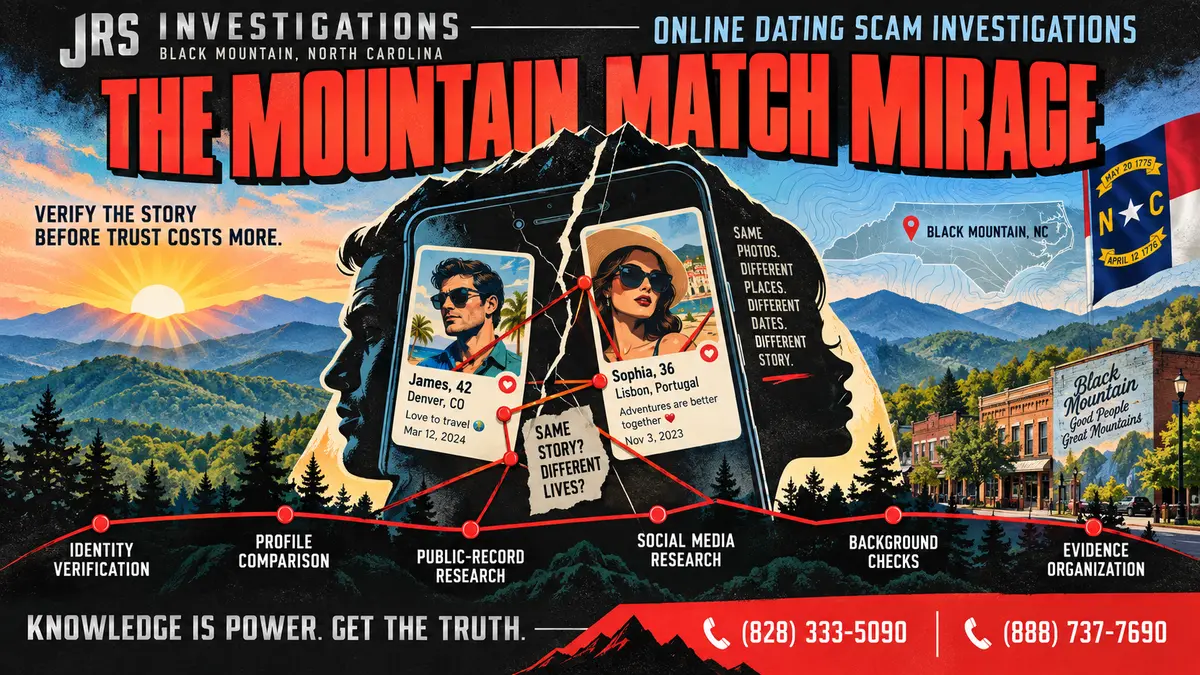
A Black Mountain online dating scam investigator can help verify whether the person behind an online profile is telling the truth before an emotional relationship becomes a serious financial loss. JRS Investigations assists clients in Black Mountain, Asheville, and western North Carolina with lawful identity verification, profile comparison, public-record research, social-media research, background checks, and organized evidence reporting.
Romance scams often begin with attention, patience, and a believable story. The person may seem unusually compatible, communicate every day, and offer convincing explanations for why an in-person meeting cannot happen. The danger usually appears later, when the relationship shifts toward money, secrecy, urgency, or requests for personal information. If something feels inconsistent, verification is not an accusation—it is a practical way to protect yourself.
What an online dating scam investigation can verify
The goal is to compare the story you were given with information that can be lawfully documented. Depending on the facts, an investigation may examine:
- Identity details: whether names, ages, locations, occupations, and other biographical claims are consistent.
- Profile images: whether photographs appear elsewhere online under different names or identities.
- Social-media history: whether accounts show a credible timeline, authentic relationships, and consistent personal details.
- Public records: whether available records support claims about residence, marriage, business ownership, litigation, or other relevant facts.
- Employment and business claims: whether a stated company, profession, or project appears legitimate and connected to the person.
- Communication patterns: whether messages, dates, explanations, and requests reveal contradictions or recognizable scam tactics.
- Known contact information: whether phone numbers, email addresses, usernames, and public-facing accounts connect to a consistent identity.
No single search proves that a relationship is genuine or fraudulent. Reliable conclusions come from comparing several independent facts and clearly separating confirmed information, inconsistencies, and unanswered questions.
Warning signs that deserve a closer look
The FBI warns that romance scammers create false identities to build trust and may later ask for money. A suspicious profile may also use a story involving overseas work, military service, construction projects, medical problems, frozen accounts, or a sudden emergency.
Consider pausing the relationship and seeking verification when several of these signs appear together:
- The person quickly declares love or pushes for exclusivity.
- They repeatedly avoid video calls or cancel in-person meetings.
- Their location, job, age, family history, or photographs do not remain consistent.
- They ask you to keep the relationship or a financial request secret.
- They request gift cards, cryptocurrency, wire transfers, payment-app transfers, checks, or access to an account.
- They ask you to receive or forward money, packages, or merchandise.
- They want copies of your identification, financial documents, passwords, or verification codes.
- They pressure you to act immediately and discourage you from speaking with family, a bank, or law enforcement.
- Their profile has very little history, few authentic interactions, or recently created accounts.
- They claim that one final payment will unlock a large inheritance, business deal, shipment, or travel plan.
A compelling explanation can still be false. Scammers often use urgency and emotional pressure because careful verification takes time.
What to do before sending money or personal information
- Stop and preserve the conversation. Save messages, profile pages, photographs, usernames, email addresses, phone numbers, payment requests, receipts, and dates. Do not alter the originals.
- Do not send additional funds. A new fee, tax, emergency, or promise of repayment is not proof that an earlier request was legitimate.
- Talk to someone you trust. A relative, friend, attorney, bank representative, or investigator may recognize patterns that are difficult to see from inside the relationship.
- Use reverse-image searching. The Federal Trade Commission recommends checking profile images and reporting suspicious accounts to the platform.
- Verify independently. Do not rely only on documents, links, phone numbers, or references supplied by the person being questioned.
- Protect your accounts. Change reused passwords, turn on multifactor authentication, and contact the relevant financial institution if account information was shared.
How JRS approaches a Black Mountain case
Every situation starts with a confidential review of what you already know and the decision you are trying to make. Some clients want to verify a name before meeting. Others have noticed contradictions after months of communication. Some contact us after money has already been requested or transferred.
JRS then develops a focused research plan based on the identifiers available. The work may combine background-check research, public records, profile comparison, social-media research, and examination of the timeline provided by the client. We document sources and findings in a clear format so you can understand what was confirmed, what conflicted, and what could not be verified.
When appropriate, a case may also draw on our broader online dating scam investigation services and local knowledge through our Black Mountain private investigator team. For matters extending across western North Carolina, see our Blue Ridge Mountains investigation services.
What a private investigator cannot promise
Responsible investigation has limits. JRS does not promise to recover money, access private accounts, obtain restricted records without legal authority, or guarantee that every person can be conclusively identified. We do not hack phones, email accounts, social-media profiles, or financial systems. We also do not represent that every online inconsistency proves criminal intent.
What we can provide is lawful research, careful comparison, documentation, and an objective assessment of the information available. If the facts indicate that a crime may have occurred, an attorney or law-enforcement agency can advise you about legal remedies and compulsory process.
If you have already sent money
Act quickly. The FTC advises consumers to contact the bank, card issuer, wire-transfer company, payment app, gift-card issuer, or cryptocurrency platform used for the payment and ask whether the transaction can be reversed or flagged. Keep every receipt and confirmation number.
- Report suspected internet crime to the FBI Internet Crime Complaint Center.
- File a consumer report at ReportFraud.ftc.gov.
- If personal identifying information was exposed, create a recovery plan at IdentityTheft.gov.
- Notify the dating or social-media platform and preserve the profile before it disappears.
- Contact local law enforcement when there is a threat, coercion, stalking, or an immediate safety concern.
Be cautious of anyone who contacts you afterward and promises guaranteed recovery for an advance fee. Recovery scams frequently target people who have already experienced a loss.
Why local context matters in Black Mountain
Black Mountain is a close-knit community within the Asheville and Blue Ridge region, but online relationships can cross county, state, and international boundaries in seconds. A profile may claim a local connection while using photographs, business details, or life events taken from someone else. Local familiarity helps an investigator evaluate addresses, businesses, travel claims, and community references without assuming that a polished profile is authentic.
JRS keeps the scope centered on the client’s question. That may mean a preliminary identity check, a deeper review of multiple profiles and aliases, or evidence organization for an attorney. Our broader investigation services can support related concerns when the facts expand beyond the original online relationship.
Frequently asked questions
Can you determine whether profile photographs are stolen?
We can compare images across publicly accessible sources and document material matches or inconsistencies. Results depend on image quality, public availability, and whether the images have been altered.
Can you verify someone before I meet them?
Yes. Early verification may examine identity details, public records, contact information, profile history, and other claims you provide. Always arrange first meetings in a public place and tell someone you trust where you will be.
Will the person know I hired an investigator?
Research is handled discreetly and lawfully. The exact approach depends on the case, but JRS does not impersonate clients, hack accounts, or use prohibited access methods.
How much information should I bring?
Provide the profile URL, displayed name, photographs, usernames, email addresses, phone numbers, claimed location and occupation, a timeline, and copies of relevant messages or payment requests. Do not delete original material.
How quickly should I act?
Before sending money or sensitive information is best. If money was already sent, contact the payment provider immediately while preserving evidence and making official reports.
Speak with a Black Mountain online dating scam investigator
If an online relationship does not add up, you do not have to choose between blind trust and a confrontation. JRS Investigations can help you verify the story, document inconsistencies, and make your next decision with clearer information.
Call JRS Investigations in western North Carolina at (828) 333-5090 or toll-free at (888) 737-7690. Knowledge is power. Get the truth.
This page provides general information and is not legal or financial advice. Investigation scope and available information vary by case and jurisdiction.