
(888) 737-7690

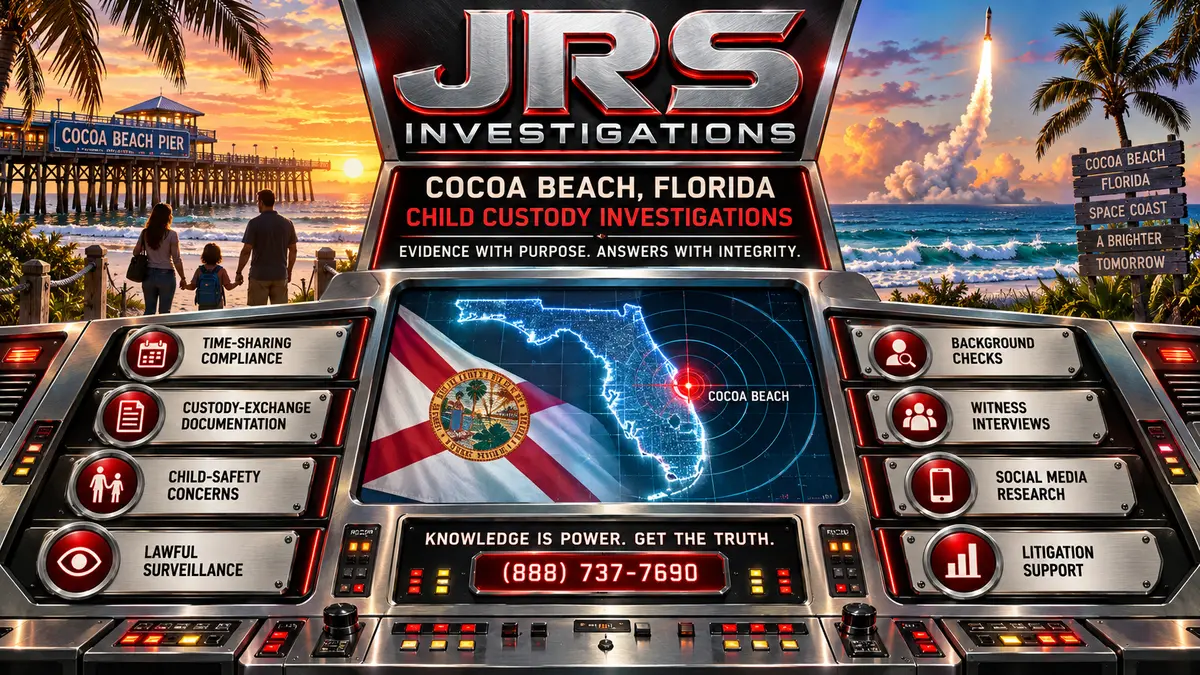
Cocoa Beach Child Custody Investigations: Evidence Guide
A Cocoa Beach child custody investigator can help parents and family-law attorneys replace conflicting allegations with a clear, time-stamped record. JRS Investigations conducts discreet, lawful investigations in Cocoa Beach and throughout Florida’s Space Coast. Our role is to document relevant facts—not to decide parenting rights, diagnose family relationships, or manufacture a case against another parent.
Florida courts generally use the terms parenting plan and time-sharing rather than relying only on the everyday word “custody.” A focused investigation may help verify compliance with an existing plan, document a recurring safety concern, locate an important witness, or preserve evidence for an attorney’s review. Every assignment should begin with a legitimate objective and a method proportionate to the concern.
What a child custody investigation can document
Family-law disputes are emotional, but useful evidence must remain objective. A professional investigation records who, what, when, and where without presenting assumptions as facts. Depending on the case and the client’s legal authority, JRS may document:
- Repeated late, missed, or incomplete child exchanges.
- Whether an authorized adult appears for a scheduled exchange.
- Publicly visible conduct that may affect a child’s safety.
- Possible violations of specific, reviewable terms in a parenting plan.
- Relevant addresses, vehicles, associates, or business connections.
- Publicly available online activity connected to a legitimate concern.
- The identity and account of an incident witness.
- A reliable chronology for counsel, mediation, or court preparation.
Evidence should answer a defined question. An isolated photograph rarely explains an entire family situation. Dates, duration, repetition, environmental conditions, and the language of the actual court order may all change the meaning of an observation.
Five reasons to hire JRS for a Cocoa Beach child custody case
1. Time-sharing and exchange documentation
When parents disagree about missed exchanges, late arrivals, unauthorized pickups, or repeated changes to the schedule, neutral documentation can clarify the pattern. An investigator may record the arrival time, departure time, participants, vehicles, and publicly visible events at an authorized exchange location. The report should describe what occurred without escalating the encounter or interfering with either parent.
JRS does not interpret a parenting plan as legal counsel. Before fieldwork, the client or attorney should identify the exact provision at issue and explain the investigative objective. That keeps the coverage focused and helps prevent irrelevant observation.
2. Lawful surveillance of public activity
Surveillance may be appropriate when credible information suggests a recurring, material safety issue that cannot be resolved through records alone. Investigators can observe conduct visible from lawful public vantage points, such as streets, public parking areas, businesses, parks, or other places without a reasonable expectation of privacy.
Cocoa Beach presents distinctive planning conditions: beach traffic, hotels, seasonal crowds, causeway travel, public parks, school-zone congestion, and movement between Cocoa Beach, Cape Canaveral, Merritt Island, and mainland Brevard County. Local knowledge helps establish realistic travel windows and safe observation positions.
3. Background and public-record research
A verified identity or address can matter when a new household member, regular caregiver, or associate is connected to a specific safety concern. JRS may use lawful public records and open sources to verify names, addresses, business affiliations, court history, or other relevant facts. A record match is not automatically proof of current misconduct; identifiers and context must be checked carefully.
JRS does not obtain protected medical, educational, financial, or other restricted records through deception. Any confidential records used to shape the assignment should come from an authorized client or attorney.
4. Witness identification and interviews
A witness may have direct information about an exchange, driving incident, recurring absence, unsafe event, or other disputed fact. When appropriate, JRS can identify and interview relevant adults professionally. Investigators do not intimidate witnesses, pretend to be government agents, or pressure someone to provide a preferred answer.
The report should identify the witness, date, method of contact, substance of the statement, and any independent information that supports or conflicts with it. Attorneys can then decide whether a formal affidavit, deposition, subpoena, or additional interview is appropriate.
5. Organized evidence for attorney review
Useful work product is more than a folder of photographs. JRS organizes notes, observation times, locations, photographs, video, vehicle information, source references, and investigative limitations into a chronological report. Original media and metadata are preserved when required. Significant developments can be communicated promptly under the agreed case protocol.
An investigator cannot guarantee that evidence will be admitted or determine what weight a judge will give it. Those are legal questions for counsel and the court. Accurate collection and neutral reporting, however, make the material easier to evaluate.
What investigators should never do in a custody dispute
A family case does not authorize unlimited surveillance. JRS will not trespass, enter a residence without permission, use unlawful tracking technology, access private accounts, impersonate another person, harass a parent, provoke misconduct, or secretly record conversations where recording would violate applicable law.
Children must be treated with exceptional care. JRS does not question or approach a minor without appropriate authorization and a clearly lawful purpose. Investigators avoid unnecessary identification of children in reports and do not publish case material. Surveillance is directed at the defined adult conduct or exchange issue, not at intruding on a child’s private life.
Parents should not recruit children to gather evidence, search another parent’s devices, or create confrontations for the camera. Those actions can endanger the child and damage the underlying case.
How the JRS investigation process works
- Confidential intake: We confirm the client’s identity and authority, identify the court status, and define the factual question.
- Document review: The client or attorney provides relevant orders, parenting-plan provisions, schedules, known vehicles, current photographs, addresses, and specific incidents.
- Conflict and feasibility review: JRS evaluates whether the objective is lawful, achievable, proportionate, and likely to produce useful information.
- Written investigative plan: We recommend methods, timing, budget, reporting expectations, and any practical limitations.
- Fieldwork and research: Investigators collect information discreetly, preserve context, and stay within the authorized scope.
- Quality-controlled report: Findings and limitations are organized for efficient review. JRS requests authorization before work exceeds the agreed scope.
Evidence that tends to be more useful
The strongest evidence usually shows a documented pattern connected to a specific issue. For example, several accurately timed exchange observations may be more informative than one emotionally charged encounter. A clear report also separates what the investigator personally observed from what a source reported.
Investigators should avoid loaded conclusions. If an adult appears impaired, the report should describe observable conduct rather than diagnose intoxication. If a vehicle departs quickly, the report should not guess its speed without a reliable measurement. If visual contact is lost, that gap belongs in the report. Precision protects credibility.
Florida parenting-plan and time-sharing context
Florida Statute 61.13 addresses parenting plans, parental responsibility, and time-sharing. Among other minimum requirements, an approved parenting plan must describe how parents will share daily responsibilities, provide a time-sharing schedule, allocate decision-making responsibilities, address parent-child communication, and designate authorized exchange locations unless the parents agree otherwise in writing.
Current statutory language and procedural requirements can change. Review Florida Statute 61.13 and the Florida Courts family-law forms, and consult a qualified Florida family-law attorney about the facts of the case. JRS provides investigative services, not legal advice.
Urgent child-safety concerns
A private investigation is not a substitute for emergency assistance or a legally required abuse report. If a child appears to be in immediate danger, call 911. The Florida Abuse Hotline accepts reports of known or suspected child abuse, neglect, or abandonment 24 hours a day at 1-800-962-2873. Do not wait for a private investigator to collect additional evidence before making an urgent or required report.
Child custody investigations across the Space Coast
JRS supports authorized assignments in Cocoa Beach and surrounding Space Coast communities. Learn more about our Cocoa Beach private investigator, child custody and domestic investigations, and surveillance investigation services.
Frequently asked questions
Can a private investigator change a parenting plan?
No. JRS gathers and reports facts. Only the parties, their attorneys, and the court can address legal changes to a parenting plan through the proper process.
Can an investigator place a tracker on the other parent’s vehicle?
Do not assume ownership or family status makes tracking lawful. JRS does not use unlawful tracking methods. Any proposed technology must be evaluated under applicable law and the specific facts before use.
Will JRS interview my child?
JRS generally avoids direct contact with minors. Any exceptional request would require appropriate authorization, a clearly lawful purpose, and careful consideration of the child’s welfare. Counsel should guide that decision.
How long does an investigation take?
The schedule depends on the question, court deadlines, reliable activity information, geography, and budget. JRS recommends a defined starting scope and expands it only with client authorization.
Discuss a Cocoa Beach child custody investigation
If you have a legitimate family-law concern that requires neutral documentation, contact JRS Investigations for a confidential assessment. We will explain what can be investigated lawfully, what information is needed, and whether the likely value justifies the proposed work.
Knowledge is power. Get the truth. Call (888) 737-7690 or contact JRS Investigations.