(888) 737-7690

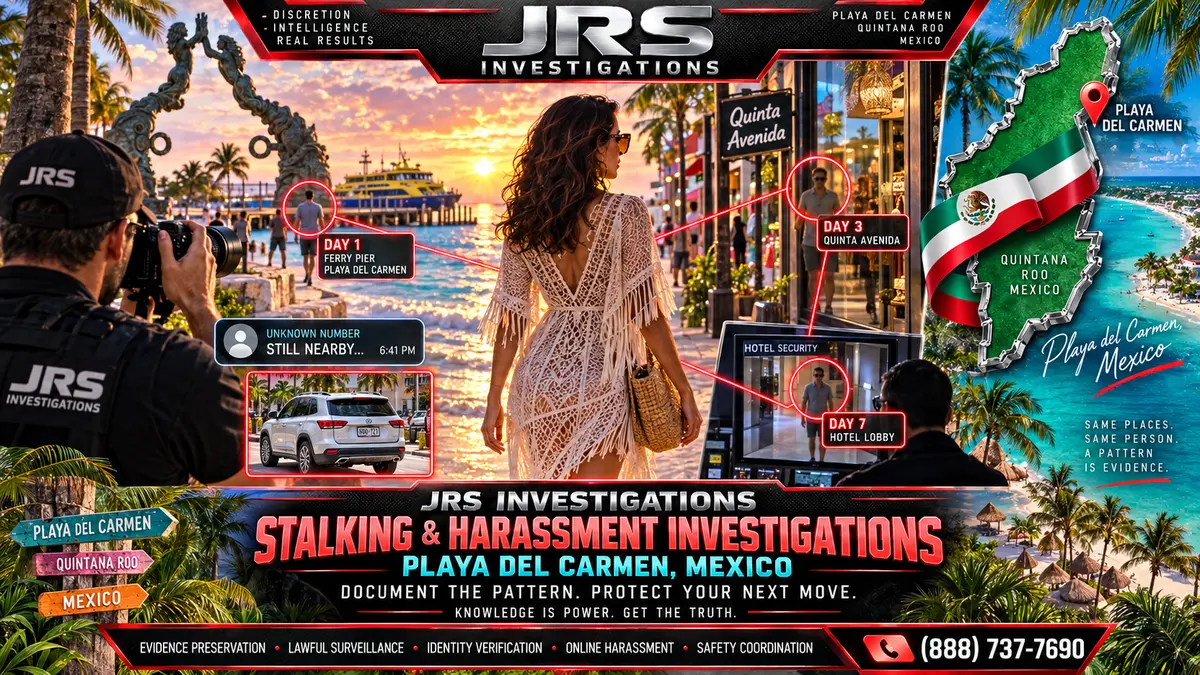
Playa del Carmen Stalking and Harassment Investigations: Evidence and Safety Guide
If you believe you are in immediate danger in Playa del Carmen, call Mexico’s emergency number, 911, move to a secure public location, and contact local authorities. JRS Investigations is not an emergency-response service.
Repeated unwanted contact can feel especially disorienting when it happens away from home. A person may appear at the same hotel, restaurant, residence, workplace, or beach club. Messages may arrive from changing accounts. A former partner, employee, acquaintance, or stranger may seem to know details that were never shared publicly. A Playa del Carmen stalking investigator can help organize these events into a clear chronology, preserve available evidence, identify lawful investigative leads, and give counsel or authorities a more useful factual record.
JRS Investigations supports individuals, families, attorneys, businesses, property owners, and visitors with discreet fact-finding in Playa del Carmen and the Riviera Maya. Every matter is scoped around applicable law, personal safety, privacy, and the client’s legitimate purpose. When local authority or specialized access is required, the work is coordinated with appropriate resources rather than improvised.
What Stalking and Harassment May Look Like in Playa del Carmen
Stalking and harassment are patterns, not merely uncomfortable moments. One incident may appear explainable on its own. The significance often emerges when locations, dates, accounts, vehicles, calls, and witnesses are compared. Relevant conduct may include:
- Repeated appearances near a home, hotel, workplace, school, marina, gym, or regular social venue
- Unwanted calls, texts, emails, gifts, social-media messages, or contact through new accounts after blocking
- Threatening, humiliating, or coercive messages sent directly or through relatives, employees, or friends
- Suspected tracking of travel, transportation, reservations, or daily routines
- Monitoring or impersonation through online profiles
- Property interference, unexplained access attempts, or suspicious deliveries
- Conduct that escalates after a separation, employment dispute, business conflict, or rejected relationship
The investigator’s role is not to label someone guilty or provoke a confrontation. The objective is to document observable facts, preserve reliable material, test reasonable explanations, and develop information that can be reviewed by the client, an attorney, security personnel, or law enforcement.
Why Professional Documentation Matters
A frightened person may have hundreds of screenshots but no usable timeline. Important metadata may be missing, duplicate messages may obscure escalation, and witnesses may remember events differently weeks later. Professional organization turns scattered material into a structured record.
Depending on the facts and legal limits, JRS may help organize:
- A dated incident log with locations, descriptions, and known witnesses
- Original messages, email headers, call records, photographs, and video supplied by the client
- Descriptions of vehicles, usernames, telephone numbers, businesses, and meeting locations
- Publicly available information connected to relevant identities or accounts
- Lawfully obtained field observations from public or authorized locations
- A concise evidence index that counsel or authorities can review efficiently
Evidence must be handled carefully. Cropping, rewriting, repeatedly forwarding, or posting material online can remove context or create avoidable disputes. Preserve original files whenever possible, note when and how each item was received, and avoid editing the only copy.
How a Playa del Carmen Stalking Investigation Can Proceed
1. Confidential intake and immediate-risk screening
The first step is a private discussion about what happened, what is known, what remains uncertain, and whether emergency or protective action is already underway. The investigator identifies the client’s lawful objective and any restrictions imposed by a court order, employer, property, or attorney.
2. Timeline and evidence review
Messages, photographs, access records, witness details, travel dates, and prior reports are organized chronologically. This often reveals repeated locations, recurring times, account changes, or escalation that was difficult to see while events were unfolding.
3. Identity and lead verification
When the source of contact is uncertain, investigators may examine lawful public records, open-source information, business connections, aliases, account indicators, and other corroborating facts. A name, photograph, phone number, or vehicle description is a lead—not proof by itself. Reliable conclusions require corroboration.
4. Lawful field investigation
Where appropriate, discreet observations may help confirm conduct, identify a vehicle, document a recurring location, or evaluate whether the same individual is repeatedly present. Surveillance is conducted only from lawful vantage points and is not used to trespass, intercept private communications, hack accounts, or enter restricted property.
5. Findings and next-step coordination
The client receives a clear summary of verified facts, unresolved questions, and supporting material. With authorization, relevant findings may be organized for counsel, corporate security, hotel management, property management, or law enforcement. The investigation does not replace legal advice or an official police investigation.
Situations JRS Can Evaluate
Former partner or relationship-related harassment. Unwanted appearances, account switching, indirect contact, and escalating messages after a breakup can require careful documentation without direct confrontation.
Workplace and corporate harassment. Owners, executives, employees, and legal teams may need help documenting threats, repeated visits, impersonation, information leaks, or conduct connected to a workplace dispute. Related services may include corporate and private investigation services.
Hotel, vacation-rental, and travel incidents. Visitors may have limited time in Mexico and may not know which records, witnesses, or camera-retention questions need prompt attention. Early preservation requests can matter because routine business systems may overwrite data.
Online harassment connected to real-world conduct. Digital messages and physical appearances may be part of the same pattern. JRS can help compare timelines and lawful identifiers while avoiding unsupported claims about anonymous accounts.
High-profile, family, or executive concerns. When exposure is elevated, investigative documentation may be coordinated with Playa del Carmen executive-protection planning. Investigation and protection have different purposes but can support the same safety strategy.
What JRS Will Not Do
Ethical limitations protect the client and the integrity of the findings. JRS will not hack an account, install unauthorized tracking software, obtain protected records through deception, trespass, impersonate law enforcement, threaten a subject, or guarantee an arrest or legal outcome. We also do not encourage clients to follow, confront, bait, or publicly accuse the person of concern.
A professional investigation should reduce uncertainty and risk. It should never manufacture a confrontation.
Practical Steps You Can Take Now
- Prioritize safety. In an emergency, call 911 and move to a secure location. The U.S. Embassy’s victims-of-crime guidance for Mexico explains that victims can report an incident through emergency services or a local police station.
- Preserve original evidence. Save complete messages, voicemails, email headers, photographs, and videos. Back them up without altering the originals.
- Start a factual incident log. Record date, time, location, exact conduct, witnesses, and any report number. Separate what you personally observed from what someone else told you.
- Limit public posting. Public accusations can reveal your location, alert the person involved, complicate the investigation, or create legal issues.
- Review digital and physical access. Change passwords from a trusted device, enable multifactor authentication, review account sessions, and speak with qualified technical or security professionals if compromise is suspected.
- Tell trusted people. Provide a photograph or description only when appropriate, establish check-in procedures, and ask hotels, offices, or residential security to follow their documented access policies.
U.S. citizens can also review the official U.S. consular agency information for Playa del Carmen. Consular personnel do not replace local police, but the official page provides current location and assistance information.
Information to Provide During Intake
A focused intake helps the investigation begin efficiently. If available, prepare the subject’s name or aliases, photographs, usernames, phone numbers, vehicle information, known associates, important addresses, prior police or court records, the incident timeline, and copies of the original communications. Tell the investigator whether counsel, law enforcement, hotel security, an employer, or a property manager is already involved.
Do not attempt to obtain missing information by entering accounts, devices, residences, hotel rooms, or restricted systems without authorization.
Frequently Asked Questions
Can an investigator prove who controls an anonymous account?
Sometimes lawful public information and corroborating behavior can identify strong leads, but an account name or photograph alone is not conclusive. Platform subscriber records generally require appropriate legal process. JRS reports what can be verified and clearly distinguishes fact from inference.
Can JRS place a tracker on someone’s vehicle?
Not simply because a client requests it. Tracking laws, vehicle ownership, consent, location, and purpose all matter. JRS will only consider methods that are lawful and properly authorized.
Will the subject know an investigator was hired?
Confidentiality and discretion are central to the assignment, but no investigator should promise absolute invisibility. The scope is designed to minimize unnecessary exposure while maintaining lawful and professional conduct.
Can your report be given to an attorney or police?
Yes, with client authorization. The material can be organized for efficient review, but the receiving attorney or agency decides how it will be used and whether further legal process is appropriate.
Do you serve visitors as well as residents and businesses?
Yes. JRS can evaluate matters involving residents, expatriates, visitors, attorneys, businesses, property owners, and families. Learn more about our broader private-investigator services in Playa del Carmen.
Speak With JRS Investigations Confidentially
If repeated unwanted contact, threats, surveillance concerns, or unexplained appearances are affecting you, early organization can prevent valuable details from being lost. Contact JRS Investigations for a confidential case assessment. We will discuss the facts, lawful options, expected limitations, and a practical scope before work begins.
Call (888) 737-7690 or email contact@jrsinvestigations.com.