(888) 737-7690
How to Hire a Private Investigator in Black Mountain, NC
Hiring a private investigator in Black Mountain, North Carolina, should begin with a specific question and a lawful plan for answering it. The best investigation is not the one with the most surveillance hours or the broadest promises. It is the one that gathers relevant, well-documented facts while respecting privacy, property rights, court orders, safety concerns, and North Carolina law.
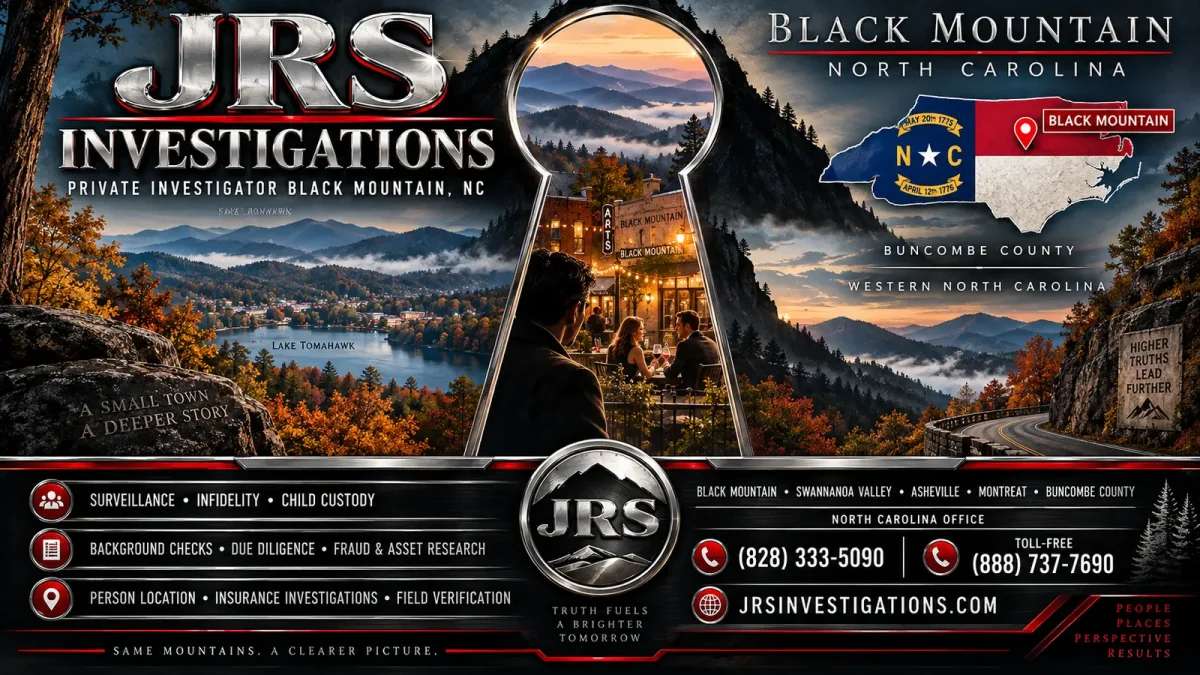
JRS Investigations serves clients with matters connected to Black Mountain, the Swannanoa Valley, Asheville, and communities across Western North Carolina. Services may include surveillance, infidelity investigations, child custody support, background checks, due diligence, fraud and asset research, person location, witness development, and insurance-related investigations. To request a confidential case review, call the North Carolina office at (828) 333-5090 or toll-free at (888) 737-7690.
What a Black Mountain Private Investigator Can Help With
Private investigations are most effective when the service matches the decision the client must make. A family-law attorney may need a documented timeline. A spouse may need objective information about unexplained absences. A business may need to verify a person, company, address, or claim before committing money. An insurer may need evidence about activity that can be lawfully observed in public.
During the initial consultation, JRS identifies the client’s legitimate purpose, the available starting information, the geographic scope, the intended use of the findings, and any deadline. The investigator can then recommend a focused first phase instead of treating every case the same way.
Surveillance and Activity Documentation
Professional surveillance can help document meetings, movements, overnight activity, work activity, vehicle use, or other conduct visible from lawful public vantage points. A useful surveillance report connects observations to dates, times, locations, photographs, and video rather than relying on impressions or assumptions.
Black Mountain surveillance requires local planning. Downtown streets, residential neighborhoods, mountain roads, commercial areas, parks, and routes through the Swannanoa Valley create different visibility and traffic conditions. Interstate 40, U.S. 70, NC 9, Montreat Road, and smaller connecting roads may influence how a subject moves. Terrain, weather, seasonal visitors, limited parking, and a community where unfamiliar vehicles may stand out can affect the operational plan.
Infidelity and Relationship Investigations
An infidelity investigation can provide objective information when travel, schedules, spending, or explanations no longer align. The work may involve documenting public meetings, identifying an unknown companion, confirming an overnight location, or establishing a timeline around selected dates.
Good planning starts with the dates and circumstances most likely to answer the client’s question. Relevant information may include a current photograph, vehicle description, work schedule, known addresses, travel plans, and the pattern that created concern. JRS does not hack phones, steal passwords, impersonate an account holder, or enter private property without permission.
Child Custody and Domestic Investigations
Child custody investigations may help document compliance with parenting schedules, public conduct during parenting time, custody exchanges, transportation, frequent companions, or conditions that can be observed through lawful means. The investigator’s role is to collect facts, not to decide which parent should prevail.
When a court order exists, the client or attorney should provide a complete current copy before fieldwork begins. JRS does not routinely approach or interview a child. Any contact involving minors, schools, medical providers, protected records, or private residences requires careful legal and ethical review. If immediate danger is suspected, contact law enforcement or the appropriate child-protection authority rather than waiting for a private investigation.
Background Checks and Due Diligence
Background and due-diligence investigations can help evaluate a prospective partner, caregiver, employee, contractor, tenant, business associate, or investment contact. A meaningful review may include identity resolution, address history, court-record research, business affiliations, employment or credential verification, adverse information, references, and inconsistencies in the subject’s stated history.
Database results are only leads until they are matched to the correct person. Names, dates of birth, prior addresses, and other identifiers must be compared carefully to reduce false matches. An investigator should explain the difference between verified information, public-record results, and information that remains unconfirmed.
Fraud, Asset, Business, and Property Research
Fraud and asset investigations may examine people, companies, public filings, addresses, property interests, litigation, transactions, and related entities that can be researched lawfully. This service can support attorneys, businesses, judgment creditors, insurers, and private clients who need a clearer picture before deciding what to do next.
Buncombe County’s official Register of Deeds search system can be one component of property and document research. A record hit alone does not establish ownership, control, value, or recoverability. The investigator’s job is to connect relevant records accurately and identify practical leads without promising that every hidden asset will be found.
Person Location and Witness Development
Person-location investigations may assist with finding a witness, family member, beneficiary, debtor, former tenant, or business contact for a legitimate purpose. Research may combine identifiers, address history, public records, social information, known associates, and field verification.
JRS screens locate requests for safety and legitimacy. Sensitive information will not be released when the request could facilitate stalking, harassment, intimidation, retaliation, or another harmful purpose. In some matters, an investigator may offer to forward a message without disclosing the person’s address.
Insurance and Workers’ Compensation Investigations
Insurers, employers, and counsel may need lawful documentation of publicly observable activity connected to an injury, disability, property, or liability claim. These assignments require a precise allegation, claim information, relevant dates, and a clear reporting standard. Surveillance does not determine medical condition or legal entitlement; it documents observed activity for the authorized client to evaluate with other evidence.
Why Black Mountain Requires a Local Field Plan
Black Mountain is part of Buncombe County and the broader Asheville-area mountain corridor, but it operates differently from a larger city. The official Town of Black Mountain website provides municipal information, public-record request options, local government resources, and current town updates. For investigative planning, the important issue is how the town’s roads, neighborhoods, public spaces, and surrounding terrain affect observation and travel.
A subject may move between Black Mountain, Swannanoa, Asheville, Montreat, Fairview, Old Fort, or more remote mountain areas during the same day. Weather can change visibility and travel time. A seemingly short distance may involve winding roads, elevation changes, road work, or few safe places to stop. Events, weekend tourism, and seasonal activity can either help an investigator blend in or make continued observation more difficult.
These factors should be considered when estimating hours, staffing, vehicle choice, and the likelihood of maintaining observation. No ethical investigator can guarantee continuous coverage through every mountain-road transition.
How to Prepare for the Initial Consultation
The quality of the starting information can materially affect cost and results. Gather only information you lawfully possess. Do not obtain passwords, protected account records, private messages, or tracking information without authorization.
- The subject’s full name, aliases, age or date of birth, and recent clear photograph
- Known home, work, family, and business addresses
- Vehicle descriptions, license plates, and usual transportation
- Typical schedule and the specific dates or patterns creating concern
- Known companions, employers, businesses, phone numbers, and social profiles
- Court orders, attorney instructions, claim documents, contracts, or transaction records
- A concise timeline separating confirmed facts from suspicions
- Safety concerns, threats, weapons, medical issues, or risk of confrontation
- The exact questions the investigation should answer
Organize documents and screenshots chronologically. A short, accurate timeline is usually more useful than hundreds of unlabeled messages. Tell the investigator what outcome would make the first phase successful.
Questions to Ask Before Hiring an Investigator
Ask how the assignment will be scoped, who will perform the work, how communication will occur, what expenses may be charged, and what the final report will include. For surveillance, clarify minimum hour blocks, travel time, mileage, cancellation terms, weather considerations, and when additional authorization is required.
North Carolina regulates private investigative activity. Prospective clients can review official licensing information through the North Carolina Department of Public Safety and its Private Protective Services resources. Verify the agency or investigator rather than relying solely on a website, social profile, or advertisement.
Be cautious of anyone who guarantees a result, claims access to every confidential database, offers unlawful phone tracking, suggests trespassing, or cannot explain how evidence will be gathered. Ethical limits are part of competent investigative work.
Reports, Evidence, and Court-Related Matters
A professional report should distinguish direct observations, photographs, records, source information, and analytical conclusions. Original media, accurate timestamps, contemporaneous notes, and documented handling practices help preserve the usefulness of evidence.
If the matter is connected to a pending case, involve the attorney early. The official North Carolina Judicial Branch page for Buncombe County provides courthouse, court-date, records, and contact resources. It does not replace legal advice. An attorney should determine what evidence is relevant, discoverable, admissible, or subject to a protective order.
Investigators do not guarantee how a judge, attorney, insurer, employer, or opposing party will interpret the findings. The objective is to deliver clear documentation that can be evaluated in the proper context.
Costs and Timelines
Investigation costs vary with the service, location, risk, number of investigators, travel, research requirements, and urgency. A background review may be priced differently from multi-day surveillance. Mountain travel and distant locations may require additional time even when the straight-line distance appears short.
JRS establishes an agreed scope and retainer before work begins. A phased approach can control costs: verify key information first, then authorize surveillance or fieldwork only if the initial findings support it. Material changes to the objective should be discussed before additional resources are committed.
Privacy, Safety, and Legal Boundaries
A private investigator is not a police officer and has no special authority to trespass, enter restricted property, obtain protected financial or medical records without lawful process, impersonate government officials, or access private accounts. JRS will not accept assignments intended to stalk, intimidate, harass, retaliate against, or endanger another person.
North Carolina services offered for Black Mountain do not include TSCM, electronic bug sweeps, or debugging. Clients seeking an investigation in this area should use the lawful domestic, surveillance, background, locate, fraud, asset, insurance, and field-verification services described on this page.
Frequently Asked Questions
Does JRS serve Black Mountain and surrounding communities?
Yes. JRS evaluates matters connected to Black Mountain, the Swannanoa Valley, Asheville, and other Western North Carolina communities. Acceptance depends on the objective, location, legality, safety, staffing, and schedule.
Can surveillance be performed on mountain roads?
Potentially, but terrain, limited routes, parking, weather, traffic, and the risk of detection affect feasibility. The investigator will explain the plan and limitations before the assignment begins.
Can JRS help with a cheating-spouse concern?
Yes, when the request has a legitimate purpose and lawful surveillance can address the question. Strong dates, locations, photographs, schedules, and vehicle information improve planning.
Can an investigator help with a Black Mountain child custody case?
Yes. JRS may document public conduct, exchanges, travel, schedules, and other relevant observations. The current court order and attorney guidance should be reviewed when litigation is pending.
Does JRS provide bug sweeps or debugging in Black Mountain?
No. JRS does not offer TSCM or debugging services in North Carolina. Black Mountain assignments focus on other lawful investigative services.
Contact JRS Investigations in North Carolina
If you need surveillance, an infidelity investigation, child custody support, a background check, due diligence, fraud or asset research, person location, witness development, field verification, or insurance-related investigation in Black Mountain, start with a confidential consultation.
Call the JRS North Carolina office at (828) 333-5090, call toll-free at (888) 737-7690, or visit JRSInvestigations.com.