
(888) 737-7690

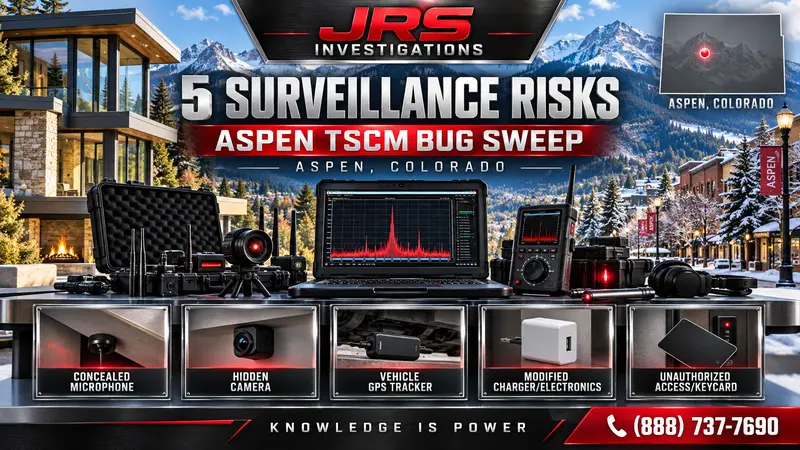
5 Surveillance Risks an Aspen TSCM Bug Sweep Can Address
An Aspen TSCM bug sweep is designed to investigate a defined concern about unauthorized audio, video or location surveillance. In a destination known for luxury residences, executive travel, private meetings, hospitality properties and major events, discretion matters—but so does a realistic understanding of what a technical surveillance countermeasures inspection can and cannot establish.
Ordinary Wi-Fi traffic, Bluetooth devices, smart-home systems and building equipment can create a busy technical environment. A professional inspection does not treat every signal, noise or misplaced object as proof of spying. It combines confidential case intake, physical inspection, technical analysis and careful verification to separate normal conditions from anomalies that deserve closer attention.
Here are five surveillance risks an Aspen TSCM assessment may be structured to address.
1. Concealed audio devices in meeting and living spaces
Small microphones or recording devices may be disguised as chargers, adapters, clocks, power strips, smoke detectors or ordinary décor. Conference rooms, executive offices, home offices, bedrooms and private gathering areas can be especially sensitive when confidential conversations take place there.
A sweep may examine the room’s physical features, accessible electronics and radio-frequency environment. Depending on the agreed scope and site conditions, the examiner may use complementary methods to investigate wireless transmitters, nontransmitting electronics, wiring irregularities or components that do not belong. No single instrument can identify every possible device, so findings must be verified rather than inferred from one alert.
2. Hidden cameras in residences, rentals and hospitality spaces
Concealed cameras can be extremely small and may be placed where a device has power, a useful viewing angle or ordinary access. Aspen assignments may involve primary residences, seasonal homes, rental properties, hotel suites, offices or event spaces. Recently serviced or newly introduced objects can deserve attention when their placement does not make sense.
A professional inspection may include a methodical visual search, examination of likely concealment points and targeted optical or electronic checks. Reflections, holes or unfamiliar electronics are not automatically evidence of a camera; they are clues to evaluate in context. If a suspicious device is located, the client should avoid handling or disconnecting it until appropriate evidence and safety guidance is obtained.
3. Unauthorized vehicle or property tracking
Location monitoring can involve a physical tracker placed on a vehicle or item, an authorized device being misused, or account-based location sharing. These are different problems and may require different specialists. A vehicle inspection can focus on accessible areas where a foreign device might be attached, while a property assessment can consider unfamiliar equipment, recent access and changes around security or utility systems.
A physical TSCM inspection does not automatically include a complete mobile-phone, cloud-account or computer-forensics examination. Suspected account compromise, stalkerware or unauthorized location sharing should be scoped separately with an appropriately qualified digital-forensics or cybersecurity professional.
4. Compromised accessories or modified electronics
Everyday electronics can create concealment opportunities because they already contain circuitry and draw power. An unfamiliar USB charger, cable, adapter, power bank, clock, network accessory or replacement component may justify closer examination when it appears after unexplained access or does not match the property’s normal equipment inventory.
The relevant question is not whether an item looks unusual at first glance. It is whether its components, placement and behavior are consistent with its stated purpose. An examiner may compare equipment to known-good devices, inspect accessible construction and use appropriate technical tools to determine whether further analysis is warranted.
5. Insider access and temporary access windows
Unauthorized surveillance usually requires opportunity. Employees, vendors, contractors, guests, household staff, maintenance personnel and former occupants may have legitimate reasons to enter a property. The concern becomes more focused when confidential information is repeatedly exposed after a specific access window or when unexplained physical changes follow service work, an event or a personnel transition.
A TSCM engagement should consider who had access, when the suspected exposure began, which conversations or activities were affected and what equipment changed during that period. This does not establish that any particular person installed a device. It helps prioritize rooms, objects and time frames so the inspection is based on facts rather than suspicion alone.
What an Aspen TSCM inspection may include
The exact process depends on the property, threat concern, available time and agreed scope. A well-planned engagement may include:
- A confidential intake covering the information at risk, timeline and known access.
- A pre-inspection review of rooms, equipment and normal wireless systems.
- A systematic visual and physical inspection of relevant accessible areas.
- Radio-frequency analysis and targeted electronic testing where appropriate.
- Verification of anomalies before conclusions are reported.
- A verbal briefing, written findings or both, depending on the assignment.
- Practical recommendations for access control, equipment inventories and follow-up.
JRS Investigations can tailor the work to residences, offices, conference spaces, vehicles and other authorized environments. Review the dedicated Aspen TSCM bug-sweep service page and the comprehensive Aspen TSCM guide for additional local information.
Aspen conditions that affect sweep planning
Large estates, smart-home systems, guest networks, security cameras, audio systems and neighboring wireless activity can produce a complex baseline. Hospitality properties and temporary residences may also have equipment or access histories that are unfamiliar to the occupant. In downtown Aspen, normal signals from nearby businesses and guests can add to the RF environment. Remote properties may present different issues, including larger inspection areas, outbuildings and limited site documentation.
These conditions do not prove surveillance. They make careful preparation and anomaly verification more important. For broader support beyond TSCM, explore JRS Investigations’ investigative services.
How to prepare for a confidential assessment
- Write down what happened, when it began and who knew the exposed information.
- Identify the rooms, vehicles, devices and conversations of greatest concern.
- List recent guests, contractors, repairs, equipment changes and personnel transitions.
- Preserve unusual messages, photographs or access records without altering suspected devices.
- Avoid broadcasting the planned inspection to anyone who does not need to know.
- Provide access to the relevant areas and identify equipment that is known and authorized.
If you find an unfamiliar device, photograph it from a safe distance if possible and avoid touching, removing or powering it off until you receive appropriate guidance. If you believe someone is in immediate danger, contact emergency services. A TSCM inspection is not a substitute for emergency response, legal advice or a full cybersecurity investigation.
Understand the limits of a bug sweep
No ethical provider should promise that a property is permanently “bug-free.” Devices can be dormant, hardwired, remotely activated, concealed in inaccessible areas or introduced after an inspection. Technical conditions also change as authorized equipment is added or removed. The purpose of a professional sweep is to assess the defined environment at a particular time using appropriate methods, document what was examined and explain any limitations.
The most useful result may be the identification of a device, the resolution of a benign anomaly, or a set of practical security improvements. Each outcome reduces uncertainty when it is supported by a disciplined process.
Schedule an Aspen TSCM bug sweep
JRS Investigations provides confidential TSCM planning for authorized residential, commercial and vehicle assignments in Aspen and surrounding Colorado communities. The first step is a discreet discussion of the concern, property, access, timeline and desired deliverables.
Call (888) 737-7690 or contact JRS Investigations to request a confidential assessment.