(888) 737-7690
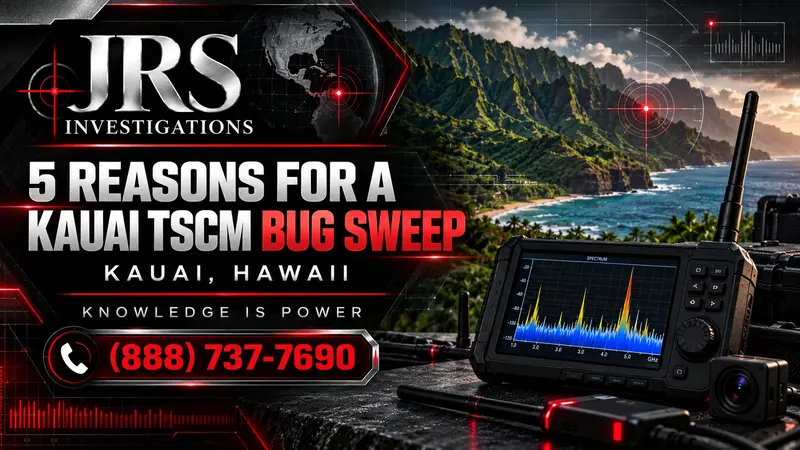
5 Reasons to Schedule a TSCM Bug Sweep in Kauai, HI
Concerns about hidden cameras, microphones, trackers, or other unauthorized surveillance can affect a home, office, vacation property, meeting space, or vehicle. A professional Kauai TSCM bug sweep provides a structured way to evaluate those concerns without relying on guesswork or consumer detector apps.
Technical Surveillance Countermeasures (TSCM) is a specialized inspection process used to look for signs of covert audio, video, radio-frequency, and related surveillance threats. The exact scope should be planned around the property, the circumstances, and the information that needs protection. Here are five practical reasons Kauai residents, property owners, executives, and organizations may consider scheduling a sweep with JRS Investigations.
1. Protect private conversations and personal spaces
Privacy concerns often begin with a pattern: confidential details become known unexpectedly, unfamiliar objects appear in a room, or someone seems to know more about a person’s movements than they should. Those warning signs do not prove that a device is present, but they may justify a careful assessment.
A TSCM inspection can focus on the areas where sensitive conversations occur, including residences, home offices, executive suites, conference rooms, guest accommodations, and other agreed-upon spaces. The goal is to evaluate the environment methodically, document relevant findings, and help the client understand reasonable next steps.
2. Safeguard business, legal, and professional information
Kauai businesses and professionals may handle confidential negotiations, financial information, client records, personnel decisions, intellectual property, or private legal strategy. Hotels, resorts, professional offices, property managers, contractors, and remote-work locations can also have frequent visitor or vendor access, creating more opportunities for an unauthorized device to be introduced.
A planned sweep can prioritize rooms and assets according to risk instead of treating every area the same. For example, an engagement may focus first on a boardroom, executive office, secured records area, or temporary meeting location. JRS Investigations can discuss the intended use of each space and define a practical inspection scope before work begins.
3. Check spaces after access, travel, or a security event
A TSCM bug sweep may be appropriate after an event that changes the risk profile of a property. Examples include renovations, a change in household or staff access, an unexplained security incident, a sensitive business negotiation, executive travel, or use of a temporary residence or meeting venue.
Timing matters. If a sweep is scheduled, clients should avoid unnecessary changes to the area beforehand. Moving objects, disconnecting equipment, or confronting a suspected person can alter the environment and may make it harder to understand what occurred. If there is an immediate safety threat, contact law enforcement or emergency services first.
4. Evaluate more than one type of surveillance concern
Covert surveillance is not limited to a traditional “bug.” Depending on the agreed scope and conditions, a professional review may consider potential listening devices, concealed cameras, radio-frequency activity, location-tracking concerns, suspicious wiring or electronics, and physical hiding places.
No single tool can identify every possible threat. Effective TSCM work combines appropriate technical methods with a physical inspection, threat-focused planning, and professional judgment. Results also depend on the space, device type, whether equipment is transmitting at the time, and the limits of the assignment. A sweep should therefore be presented as a careful risk-reduction measure—not an absolute guarantee.
For an overview of common categories of devices, see four devices a Hawaiian Islands TSCM bug sweep may find.
5. Receive documented findings and a practical response plan
The value of a professional inspection extends beyond locating a suspicious object. Clients also need clear communication about what was examined, what was observed, any limitations, and which actions make sense afterward. Depending on the situation, next steps may include preserving an item, contacting an attorney or law enforcement, adjusting access controls, improving physical security, or arranging a follow-up inspection.
Do not remove, open, disable, or destroy a suspected device without guidance. Handling it could create a safety issue, damage potential evidence, or interfere with legal options. JRS Investigations can document observations within the agreed scope and explain when another qualified professional or authority should be involved.
What a Kauai TSCM consultation should cover
Before the inspection, be prepared to discuss:
- The property or vehicle to be assessed and who controls access to it.
- The rooms, conversations, or information considered most sensitive.
- Recent events that created concern and when they occurred.
- Any unfamiliar devices, changes, interference, or unauthorized access noticed.
- Whether an attorney, security professional, property manager, or law-enforcement agency is already involved.
This information helps establish priorities and an appropriate scope. It also prevents a technical inspection from being confused with a cybersecurity, digital-forensics, or criminal investigation. Those services may overlap in some situations, but they are not interchangeable and may require separate specialists.
TSCM services for Kauai, Hawaii
JRS Investigations provides discreet consultation for residential and professional privacy concerns in Kauai. Learn more about Kauai TSCM bug-sweep services or read the comprehensive Kauai TSCM guide for additional planning considerations.
If you have a specific concern, use the confidential contact form or call (888) 737-7690. Share only the information needed to arrange a consultation, and use a device or communication method you believe is safe.
Important: A TSCM inspection cannot guarantee that every surveillance method will be detected, and it does not replace emergency assistance, legal advice, law-enforcement investigation, or a cybersecurity assessment. If you believe you are in immediate danger, call 911.