(888) 737-7690
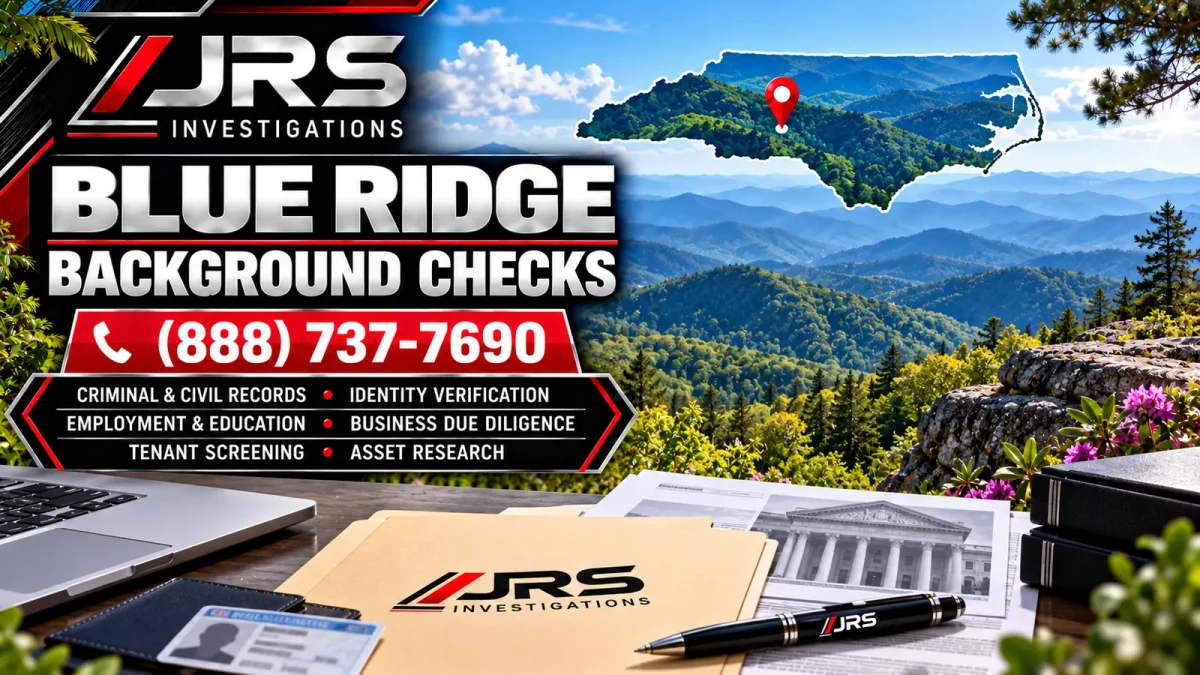
Blue Ridge Background Checks: What JRS Can Verify
Blue Ridge background checks should answer a defined question, not produce a pile of unverified search results. JRS Investigations conducts lawful background research for individuals, attorneys, businesses, property owners, and families across Western North Carolina. We verify identity, review relevant public records, confirm credentials, develop business and asset leads, and explain the limits of every finding.
The Blue Ridge Mountains cover a broad region rather than a single city. A subject may live in Asheville, Black Mountain, Hendersonville, Brevard, Lake Lure, Waynesville, Boone, or a rural community while working, owning property, or appearing in court records elsewhere. That geography makes careful county-by-county and statewide research important. JRS scopes the search around the person, purpose, time period, and decisions the client needs to make.
What a professional background investigation adds
Automated websites often combine records from people with similar names, repeat outdated information, and omit the source needed to evaluate a result. A professional investigation begins with identity resolution and follows material facts back to reliable records. We distinguish confirmed information from possible matches and unresolved leads.
The goal is not to collect every available detail about someone. It is to answer a legitimate question with proportionate research. A litigation background inquiry, pre-employment screen, dating-safety review, caregiver check, tenant investigation, and corporate due-diligence assignment each require a different scope and legal basis. Our broader background-check services explain how the purpose shapes the work.
Eight background-check services JRS can provide
1. Identity, alias, and address verification
A reliable search starts with the correct person. JRS can compare full names, aliases, age indicators, known addresses, contact information, relatives, business connections, and other lawful identifiers. We look for inconsistencies and confirm whether records likely refer to the subject or to someone with a similar name.
Address research can help with litigation, locating witnesses, reconnecting with family, verifying a residence, or investigating a person who appears to have moved. When the main objective is location rather than screening, our missing-person and skip-tracing services may be a better fit.
2. North Carolina criminal and civil court research
Court-record research may identify pending cases, convictions, civil disputes, judgments, liens, or other filings relevant to a lawful purpose. The North Carolina Judicial Branch explains that certified criminal searches are available through county clerks and that self-service searches can be conducted at courthouses. It also warns that an online name search is not the same as a certified statewide background check.
JRS evaluates name matches with identifiers, jurisdiction, dates, disposition, and context. An arrest is not a conviction. Dismissed, expunged, sealed, or restricted records require special care. We report what the accessible record shows and avoid character conclusions that the evidence does not support.
3. Employment, education, license, and credential verification
Resume and application verification can confirm employers, job titles, dates, schools, degrees, professional licenses, and other credentials when the source and law permit. The scope may also include checking whether a claimed business exists or whether a professional license is current and belongs to the right person.
Verification results are precise. “Unable to verify” does not automatically mean “false.” Records may be archived, names may have changed, an employer may have closed, or a source may require written authorization. We document the request, response, and limitation so the client can decide what additional step is reasonable.
4. Business ownership and due-diligence research
Before entering a partnership, investment, acquisition, vendor relationship, or major contract, a client may need to verify the principals and entities involved. JRS can research company registrations, officer and manager associations, business addresses, related entities, litigation, regulatory information, news coverage, and other open-source indicators.
A listed company role does not prove ownership of every company asset, and a similar business name may refer to an unrelated entity. We build a relationship map and identify which links are documented, which are inferred, and which remain unconfirmed. Clients needing fraud-specific support can review our North Carolina corporate-fraud investigation guide.
5. Tenant and residential screening support
Property owners may need to verify identity, rental history, employment, prior evictions, or material court records. Screening must follow the Fair Credit Reporting Act, fair-housing requirements, state law, and any rules that apply to the source or decision. Criteria should be consistent and connected to a legitimate housing purpose.
If a consumer report influences an adverse decision, the person may have notice and dispute rights. The Federal Trade Commission’s tenant background-check guidance explains the importance of accuracy, disclosure, and correcting information that is incomplete or belongs to someone else. JRS discusses the requested use before accepting the assignment.
6. Dating, premarital, caregiver, and personal-safety checks
Personal cases may involve identity verification, undisclosed marriages, inconsistent addresses, financial or civil warning signs, criminal-record research, business claims, or evidence of a fabricated online persona. Caregiver inquiries may also include credential, employment, and regulatory checks where authorized.
The North Carolina Sex Offender and Public Protection Registry is one official public-safety resource, but a registry result is only one component of a careful review. JRS does not use protected information to harass, threaten, or discriminate against anyone. When current conduct must be documented, a separately scoped surveillance investigation may be appropriate.
7. Property, lien, bankruptcy, and asset leads
Asset-oriented research may identify real-property connections, businesses, recorded liens, judgments, bankruptcy filings, vehicles or other ownership indicators. These findings can support due diligence, litigation planning, support matters, or judgment recovery. They do not automatically prove present ownership, value, equity, or legal reachability.
Investigators cannot lawfully provide secret bank balances or private tax records without consent or valid legal process. A “banking affiliation” in a public filing is not the same as an account balance. For matters requiring a broader ownership review, see our hidden-asset investigation service.
8. Social-media, news, and open-source intelligence
Public online material may help verify employment claims, affiliations, locations, business activity, statements, or relationships. JRS preserves relevant content with the source and date, then compares it with other evidence. We do not bypass privacy controls, impersonate another person to gain access, or treat an anonymous post as established fact.
Online content can be altered, fabricated, copied, or taken out of context. A screenshot alone may not establish authorship. When a post could matter in litigation, counsel should decide whether additional preservation, authentication, or discovery steps are needed.
Employment background checks require a compliant purpose
When an employer uses a third-party consumer report for hiring, promotion, retention, or reassignment, federal requirements may apply. The FTC’s employment background-check guidance explains disclosure, written permission, notice, report-copy, and dispute protections. Employers should use counsel or a qualified compliance professional to establish their screening policy and adverse-action process.
JRS confirms the intended use, authorization, identifiers, requested jurisdictions, and relevant time period before work begins. We do not recommend a hiring decision or substitute investigative findings for a consistent, job-related evaluation.
Protected records and lawful access
- Credit reports: require a permissible purpose and the procedures applicable to consumer reporting.
- Driving records: access and use are limited by the Driver’s Privacy Protection Act and North Carolina law. The N.C. Division of Motor Vehicles describes valid-purpose and authorization requirements.
- Medical and educational records: private records generally require authorization or another lawful basis.
- Sealed or expunged material: is not treated as ordinary public information.
- Private accounts and devices: are not accessed through password guessing, pretext, hacking, or unauthorized monitoring.
Clients should be cautious of anyone promising unrestricted database access, guaranteed completeness, private bank balances, or “everything” about a subject. Those claims ignore the legal and practical limits that protect people from misuse and mistaken identity.
How the Blue Ridge investigation is planned
Define the decision
We first identify the decision or dispute the research must support. That defines the lawful purpose, records, time period, geographic scope, and level of verification. A narrow question usually produces a clearer and more economical investigation.
Resolve the subject’s identity
Full legal name, aliases, date of birth when lawfully available, current and prior addresses, phone numbers, email addresses, employers, relatives, and business names help separate the subject from similar-name records. We tell the client which identifiers are essential and avoid collecting unnecessary sensitive data.
Search the relevant counties and sources
Western North Carolina cases may involve Buncombe, Henderson, Transylvania, McDowell, Haywood, Madison, Polk, Rutherford, Watauga, or other counties. The search plan follows verified residence, employment, court, and business connections rather than assuming one county covers the full history.
Corroborate and report
Material findings are cross-checked when possible. The report identifies sources, dates, matching identifiers, dispositions, and limitations. Confirmed facts, likely associations, and unresolved leads are labeled separately. Supporting records are organized so the client or attorney can review the basis for each conclusion.
What affects timing and cost
Timing depends on the quality of starting identifiers, the number of names and jurisdictions, courthouse or registry access, verification response times, travel, and whether fieldwork is needed. Rural locations and multiple counties can add time. Employment or school verification may also depend on the source’s release requirements and response schedule.
JRS recommends a staged budget. The first phase can resolve identity and search the most relevant records. The client can review those results before authorizing interviews, site visits, surveillance, additional counties, or asset work. This keeps the scope tied to the decision and avoids paying for low-value searches.
Frequently asked questions
Is an online criminal search enough?
Not always. Coverage, update schedules, identifiers, and disposition details vary. North Carolina’s Judicial Branch describes different options for county, statewide, certified, and non-certified searches. The correct method depends on the purpose and required level of assurance.
Can you guarantee that a background check is complete?
No. Records can be restricted, delayed, inaccurate, filed under another name, or maintained outside the searched jurisdictions. JRS explains the scope and limitations so the client knows what was and was not checked.
Can JRS run a check without the subject’s permission?
Some public-record and open-source research may be lawful without consent, while employment, tenant, credit, driving, and other regulated uses can require authorization, disclosure, or a specific permissible purpose. We review the intended use before accepting the case.
Do you serve the entire Blue Ridge region?
JRS serves Western North Carolina and can coordinate assignments based on location, scope, licensing, and availability. Visit our Blue Ridge Mountains private-investigator page for local service information or our areas served page for broader coverage.
Request a confidential background-investigation consultation
Tell JRS what decision you need to make, why the information is relevant, and which identifiers and locations are already known. We will recommend a focused scope, explain authorization needs and limitations, and provide a clear starting plan.
This page provides general information and is not legal advice. Services depend on lawful purpose, authorization, jurisdiction, available records, and case-specific facts. Results are never guaranteed.