
(888) 737-7690

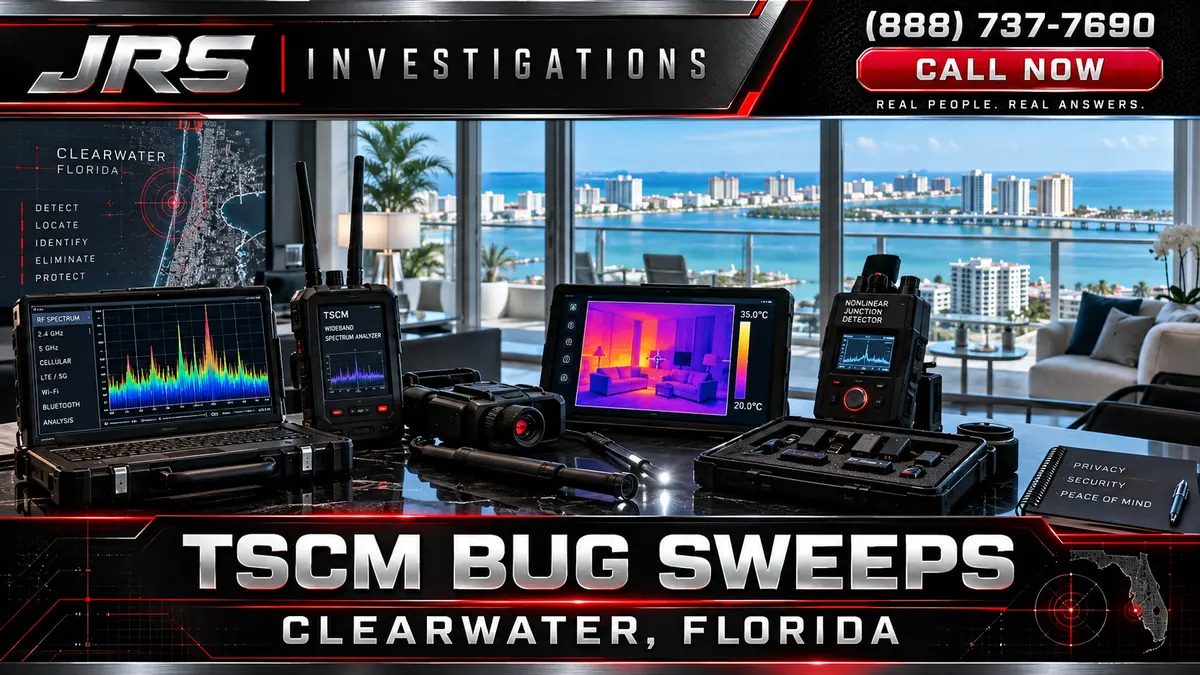
TSCM Bug Sweeps in Clearwater, Florida: What to Expect
Concerns about hidden microphones, covert cameras, wireless transmitters, or unauthorized monitoring deserve a measured response—not guesswork. Professional TSCM bug sweeps in Clearwater, Florida use layered technical and physical inspection methods to evaluate homes, offices, vehicles, meeting spaces, and temporary accommodations for signs of electronic surveillance.
JRS Investigations helps clients understand what can be examined, what a sweep can and cannot prove, and how to protect the integrity of the inspection. This guide explains when a Technical Surveillance Countermeasures assessment may be appropriate, how the process works, and what Clearwater clients should expect before, during, and after the sweep.
Why Clearwater Properties Require a Practical TSCM Plan
Clearwater includes waterfront homes and condominiums, professional offices, medical and legal practices, hospitality properties, executive travel, and a steady flow of short-term guests. Each setting creates a different inspection environment. A condominium may contain dense neighboring wireless traffic. An office may have conference-room electronics, structured cabling, access-control equipment, and multiple authorized network devices. A rental or hotel suite may contain unfamiliar fixtures and equipment that the occupant does not control.
Those conditions do not mean surveillance is present. They do mean that an effective assessment must distinguish ordinary electronic activity from anomalies that warrant closer examination. A handheld detector alone cannot reliably make that distinction. TSCM is a process that combines equipment, experience, documentation, and context.
When to Consider a TSCM Bug Sweep
A sweep is most useful when there is a specific privacy concern, a sensitive upcoming event, or a meaningful change in access to the property. Common reasons clients request a Clearwater TSCM inspection include:
- Confidential business information appears to be known by an unauthorized person.
- A former employee, contractor, partner, tenant, or personal acquaintance recently had access to the space.
- There is concern about covert audio or video monitoring during litigation, negotiations, executive meetings, or a domestic dispute.
- An unfamiliar electronic device, cable, charger, adapter, smoke detector, or network component appears without a clear explanation.
- A residence, office, rental property, or vehicle needs to be assessed before sensitive conversations occur.
- A client wants a preventive inspection after construction, maintenance, cleaning, or vendor access.
One unusual sound, a battery that drains quickly, or interference on a phone is not proof of surveillance. Our related article on warning signs that may justify a Clearwater TSCM sweep explains why multiple facts and access history matter more than a single symptom.
What a Professional TSCM Sweep Includes
Technical Surveillance Countermeasures is not one scan with one tool. The scope should reflect the property, the suspected threat, the available time, and the client’s lawful authority to authorize the work. A well-planned sweep generally includes several complementary stages.
1. Confidential Intake and Threat Assessment
The process begins with a confidential discussion about the concern, who has had access, which rooms or vehicles matter most, and whether any unexplained disclosure or device has already been observed. This allows the inspection team to prioritize likely access points and select appropriate methods rather than treating every assignment as identical.
2. Authorization and Scope Confirmation
Before work begins, the person requesting the inspection should have authority over the property, room, vehicle, or equipment being examined. Shared workplaces, leased spaces, hotel rooms, common areas, and employer-owned systems can involve additional restrictions. If authority is unclear, legal guidance may be needed before any equipment is opened, disconnected, or accessed.
3. Detailed Physical Inspection
Many surveillance devices are concealed in ordinary objects or installed where power, line of sight, or wiring is available. A physical inspection examines the environment for altered fixtures, unexplained openings, displaced items, unusual power sources, suspicious cabling, and components that do not fit the room’s normal use. This stage is essential because some devices store information locally and may not transmit during the sweep.
4. Radio-Frequency and Spectrum Analysis
RF analysis evaluates the surrounding radio-frequency environment and helps identify signals that merit investigation. Clearwater condominiums, hotels, and office buildings can contain numerous legitimate signals from neighboring Wi-Fi networks, Bluetooth accessories, cellular devices, building systems, and consumer electronics. The objective is not simply to find activity; it is to characterize signals, locate their source when possible, and determine whether they correspond to authorized equipment.
5. Nonlinear Junction Detection and Supporting Methods
A nonlinear junction detector can help locate semiconductor components even when a device is powered off or not transmitting. Depending on the scope, supporting methods may also include thermal examination, optical inspection for camera lenses, analysis of telephone or data lines, and review of accessible wireless or network devices. No single instrument is conclusive in every environment, which is why findings must be compared across methods.
6. Documentation and Client Briefing
After the inspection, the client should receive a clear explanation of the areas examined, methods used, notable observations, limitations, and recommended next steps. If a suspicious item is discovered, avoid destroying, dismantling, or publicly discussing it. Preservation, photography, access control, and coordination with counsel or law enforcement may be more important than immediate removal.
Clearwater Spaces Commonly Examined
Homes, Condominiums, and Waterfront Residences
Residential sweeps may focus on bedrooms, home offices, living areas, security systems, chargers, appliances, and locations recently accessed by visitors or service providers. In multi-unit buildings, nearby legitimate transmissions can complicate RF analysis, making physical inspection and source identification especially important.
Offices and Professional Meeting Areas
Business assignments may include executive offices, conference rooms, reception areas, communications equipment, and spaces used for legal, financial, medical, or personnel discussions. The inspection should be coordinated discreetly so normal operations do not alter the electronic environment or alert an unauthorized person.
Hotels and Short-Term Accommodations
Temporary accommodations present unique limitations because the guest may not control building systems or have authority to open fixtures. A lawful inspection can still assess accessible objects and the immediate environment, but the permitted scope should be confirmed in advance.
Vehicles
Vehicle work may address concerns involving trackers, recording devices, or unfamiliar electronics. Ownership, lawful control, aftermarket equipment, telematics, and the vehicle’s normal wiring all affect the inspection. A complete assessment may require both electronic analysis and a systematic physical examination.
How to Prepare Without Compromising the Sweep
- Do not announce the inspection to people who do not need to know.
- Keep the environment as normal as possible and avoid moving suspicious objects.
- Prepare a list of people with recent access, renovations, repairs, deliveries, or equipment changes.
- Identify the most sensitive rooms, conversations, dates, and information involved.
- Gather network names, device lists, floor plans, or vehicle information when available.
- Arrange lawful access to locked rooms, panels, offices, and vehicles included in the agreed scope.
Do not conduct repeated amateur scans immediately before the appointment. Consumer apps and inexpensive detectors can produce false positives, change device behavior, or create unnecessary confusion. If you find something concerning, photograph it from a safe distance, restrict access, and discuss it confidentially with the investigator.
Legal and Practical Limits in Florida
A TSCM sweep is a defensive inspection. It does not authorize entry into another person’s property, interception of communications, access to accounts, or examination of devices outside the client’s lawful control. Florida’s communications-surveillance laws are detailed in Florida Statutes section 934.03. Because facts and exceptions matter, clients facing a legal dispute should obtain advice from a qualified Florida attorney.
No responsible provider should promise that a sweep can establish absolute certainty for all time. Devices can be intermittent, remotely activated, well concealed, removed before arrival, or located outside the authorized search area. A professional report should state those limitations honestly and recommend reasonable follow-up measures when risk continues.
Choosing a Clearwater TSCM Provider
Ask how the provider develops the threat assessment, which complementary methods may be used, how dense wireless environments are analyzed, and what documentation follows the inspection. A credible provider should discuss authorization, confidentiality, limitations, and evidence handling before making claims about results.
JRS Investigations offers Clearwater TSCM bug-detection services and broader Technical Surveillance Countermeasures services. Our approach emphasizes a defined scope, layered inspection methods, discretion, and understandable reporting rather than exaggerated guarantees.
Watch: Clearwater TSCM Bug Detection Sweeps
Frequently Asked Questions
How long does a TSCM sweep take?
Timing depends on the property size, number of rooms or vehicles, electronic complexity, access, and the level of concern. A detailed intake allows JRS Investigations to estimate the appropriate scope before scheduling.
Can a sweep find devices that are turned off?
Some non-transmitting electronics may be identified through physical inspection or tools such as nonlinear junction detection. Results depend on concealment, construction, access, and the agreed inspection scope.
Can you inspect a condominium or hotel room?
Accessible areas under the client’s lawful control may be examined. Shared building systems, neighboring units, and fixtures owned by another party can limit what may be accessed or altered.
Should Wi-Fi and electronics be turned off first?
Usually, leave the environment in its normal state unless the investigator gives different instructions. Known devices can be documented and selectively controlled during the sweep as part of signal identification.
What happens if a suspicious device is found?
The appropriate response depends on the device, safety considerations, and the client’s legal objectives. Documentation and preservation may be preferable to immediate removal. Counsel or law enforcement can be involved when circumstances warrant.
How often should a business schedule sweeps?
There is no universal schedule. Risk-based inspections may be appropriate before sensitive meetings, after unusual access or staff changes, following renovations, or as part of an executive-security program.
Schedule a Confidential Clearwater TSCM Consultation
If you have a credible privacy concern in Clearwater, start with a confidential conversation about the property, access history, and objectives. Contact JRS Investigations or call (888) 737-7690 to discuss an appropriate TSCM scope.