(888) 737-7690
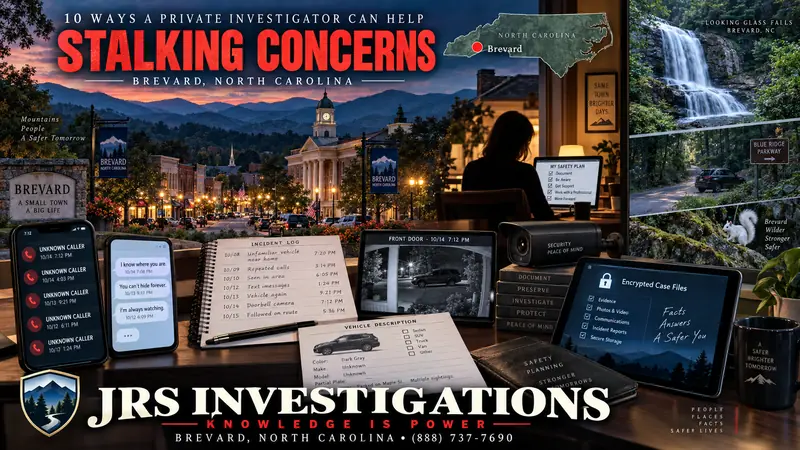
10 Ways a Private Investigator Can Help With Stalking Concerns in Brevard, NC
Repeated unwanted contact, unexpected appearances, threatening messages, or signs that someone is monitoring your movements can be frightening. Stalking concerns should be taken seriously, but the safest response is usually a coordinated plan—not direct confrontation or an attempt to investigate the person yourself.
A Brevard NC stalking investigator can help organize facts, document lawful observations, identify evidence gaps, and support communication with an attorney or law enforcement. JRS Investigations approaches these matters with discretion, objective reporting, and careful attention to the client’s safety and legal authority.
If you believe you are in immediate danger, call 911, move to a secure location, and follow law-enforcement instructions. A private investigator is not a substitute for emergency services.
10 Ways a Private Investigator May Help With Stalking Concerns
1. Build a clear incident timeline
Stalking often involves a pattern rather than one isolated event. An investigator can help organize dates, times, locations, messages, witnesses, vehicles, photographs, and prior reports into a consistent chronology. A well-structured timeline makes it easier to explain what occurred and identify escalation or repeated behavior.
2. Preserve available evidence
Texts, emails, voicemails, social-media messages, call logs, letters, gifts, photographs, and doorbell-camera clips may be important. Preserve original files whenever possible, record when and how they were received, and avoid altering or repeatedly forwarding them. An investigator can help catalog lawfully available material and note its source.
3. Document recurring activity from lawful locations
When appropriate, an investigator may observe and document conduct visible from public or otherwise authorized locations. The objective is neutral fact gathering—not confrontation. Time-stamped notes, photographs, video, and witness information may help establish whether the same person or vehicle appears repeatedly.
4. Identify vehicles or other factual leads
A partial license plate, vehicle description, business name, username, email address, or repeated phone number may provide a starting point. Investigators use lawful sources and authorized databases to develop leads. They should not hack accounts, impersonate someone, or obtain protected information through deception.
5. Review public records and open-source information
Publicly available court records, business filings, property information, and openly accessible online content may help confirm identity, relationships, addresses, or prior legal matters. The purpose is to clarify relevant facts, not to expose private information or encourage retaliation.
6. Look for connections between separate incidents
Unwanted contact may occur through different accounts, phone numbers, vehicles, gifts, or third parties. A careful review can compare timing, language, recurring locations, and other non-sensitive indicators. Investigators should distinguish confirmed connections from reasonable leads and unsupported assumptions.
7. Assess possible tracking or monitoring concerns
If you suspect an unauthorized tracker, hidden camera, listening device, or other physical monitoring, JRS can discuss whether a technical surveillance countermeasures inspection is appropriate. Consumer apps and low-cost detectors can produce false alarms and miss dormant or non-transmitting devices. Do not destroy a suspicious item; preserve the area and seek professional guidance.
8. Coordinate findings with an attorney
An attorney can advise on protective orders, court filings, evidence requirements, and legal strategy. An investigator can provide organized documentation and factual reports for counsel to review. This division of roles helps keep the investigation focused and avoids presenting investigative opinions as legal advice.
9. Support communication with law enforcement
Police determine whether a crime occurred and what enforcement action is appropriate. A concise incident summary, preserved messages, witness names, and organized documentation can make a report easier to understand. An investigator does not replace law enforcement and should not interfere with an active police investigation.
10. Develop practical security recommendations
Every situation is different. Recommendations may involve improved exterior lighting, updated locks, camera placement, visitor procedures, account-security review, safer travel routines, or coordination with trusted contacts. Security changes should reduce risk without encouraging the client to test, confront, or provoke the suspected person.
Recognizing a Pattern of Unwanted Conduct
Potential stalking behavior may include repeated unwanted calls or messages, following, appearing at a home or workplace, leaving unwanted items, monitoring online activity, contacting friends or family, making threats, damaging property, or using technology to track a person. Any one event may have another explanation; repeated conduct and the surrounding context matter.
Keep contemporaneous notes rather than relying on memory weeks later. Record what happened, when and where it occurred, who witnessed it, and whether a report was made. Separate facts from conclusions. For example, “a gray SUV remained across from the office from 3:10 to 3:42 p.m.” is more useful than “the stalker watched me all afternoon” when identity has not been confirmed.
Brevard, North Carolina Investigation Considerations
Brevard and Transylvania County include a compact downtown, residential neighborhoods, college activity, rural roads, forests, waterfalls, trail access, and travel toward Asheville, Hendersonville, Pisgah Forest, and nearby mountain communities. These conditions can affect visibility, cellular coverage, travel time, and the availability of witnesses or camera footage.
Mountain roads and outdoor recreation also create ordinary reasons for the same vehicle or person to appear more than once. Professional documentation must account for alternative explanations. The goal is to establish reliable facts without exaggerating coincidence or assuming intent.
Digital Safety and Evidence
If account compromise is suspected, use a safe device to contact a qualified cybersecurity or digital-forensics professional. Change passwords from a device you reasonably believe is secure, enable multi-factor authentication, review active sessions, and preserve suspicious notifications. Do not attempt to access another person’s accounts or install retaliatory monitoring software.
Location sharing can occur through family accounts, vehicle apps, photo metadata, social platforms, shared calendars, and Bluetooth tracking devices. A safety review should consider authorized access and ordinary shared services before concluding that a device has been hacked. Some changes may alert the suspected person, so coordinate significant steps with law enforcement, counsel, or a safety professional when risk is high.
What a Private Investigator Cannot Promise
No ethical investigator can guarantee that stalking will be proven, that a protective order will be issued, or that law enforcement will make an arrest. An investigation is limited by lawful access, available evidence, timing, visibility, and the approved scope. The value lies in careful documentation, objective analysis, and a clearer factual record.
JRS does not accept assignments intended to locate, monitor, intimidate, or obtain private information about a victim for an abusive person. Before accepting a case, investigators may ask questions about the relationship, purpose, court orders, property rights, and intended use of the information.
How to Prepare for a Confidential Consultation
- Create a short timeline of the most significant incidents.
- Preserve original messages, recordings, photographs, and video.
- List known witnesses, vehicles, usernames, and phone numbers.
- Note any police reports, court orders, attorneys, or pending hearings.
- Explain immediate safety concerns and any recent escalation.
- Do not confront the suspected person or announce the investigation.
A focused consultation helps determine what questions an investigation can realistically answer, what evidence already exists, and whether another professional should be involved first.
Speak With a Brevard NC Stalking Investigator
If you are experiencing repeated unwanted conduct and need objective documentation, contact JRS Investigations to discuss a lawful, safety-conscious plan for Brevard and western North Carolina. If the situation is urgent or threatening, contact law enforcement immediately.
Knowledge is power. Call JRS Investigations at (888) 737-7690.