
(888) 737-7690

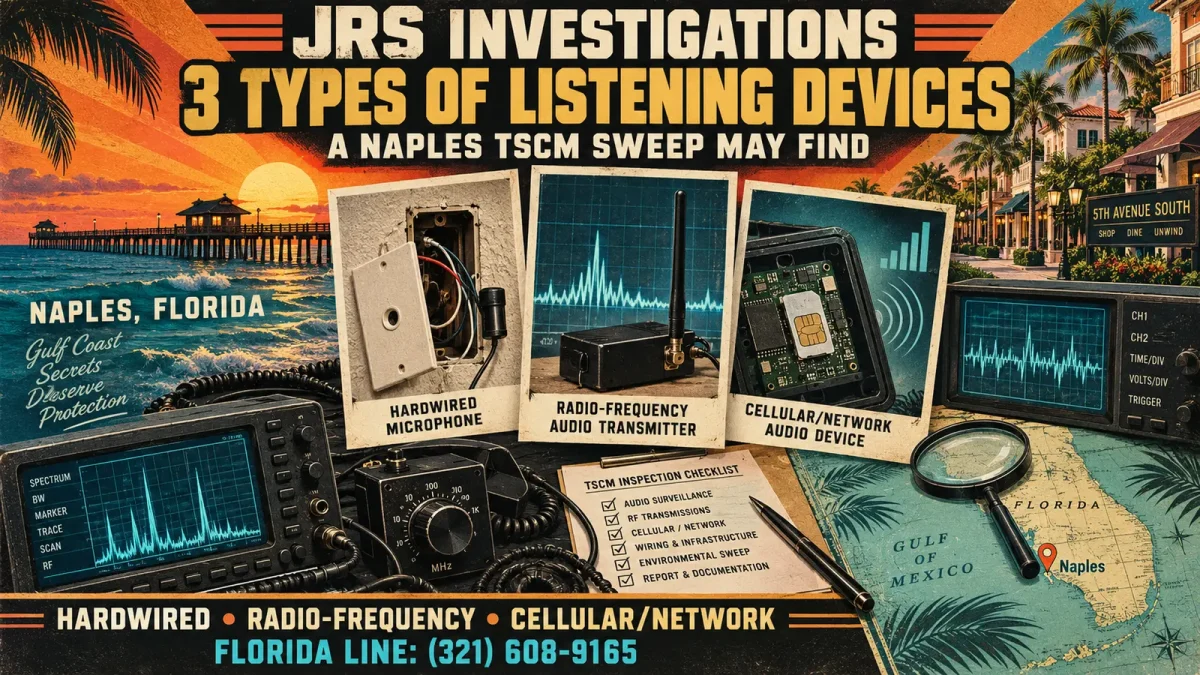
3 Types of Listening Devices a Naples TSCM Sweep May Find
Concerns about private conversations being overheard can arise in a residence, office, conference room, vehicle, hotel, or other sensitive space. However, static on a phone, an unfamiliar wireless signal, or another person knowing private information does not by itself prove that a listening device is present. Modern properties contain many legitimate electronics, and a professional Naples TSCM bug sweep is designed to evaluate the environment methodically instead of relying on assumptions.
Technical Surveillance Countermeasures (TSCM) combines physical inspection, technical testing, and case-specific analysis to look for unauthorized surveillance equipment and related vulnerabilities. Listening devices differ in how they receive power, capture audio, store information, and transmit it. The following three broad categories illustrate what an investigator may evaluate during a lawful inspection.
1. Hardwired microphones and wired listening devices
A hardwired listening device uses concealed wiring to carry audio, power, or both. It may connect to another room, a recording device, a telephone or intercom circuit, or a separate transmitter. Because a wired microphone does not need to broadcast a radio signal, a basic radio-frequency detector may not identify it.
Possible concealment areas include wall plates, outlets, ceiling fixtures, vents, furniture, cable pathways, and equipment already connected to power. Investigators look for wiring that does not match the expected installation, unexplained modifications, unusual components, and other physical anomalies. The construction and accessibility of the property affect what can be examined, so the scope should be discussed before the sweep begins.
2. Radio-frequency audio transmitters
Wireless listening devices can transmit captured audio to a receiver through radio-frequency signals. Depending on the equipment, transmission may use conventional radio bands, Bluetooth, Wi-Fi, or another short-range or network-based method. Some devices operate continuously, while others transmit intermittently, activate when sound is detected, or respond to a remote command.
A TSCM investigator may use spectrum-analysis and near-field techniques to evaluate active signals and locate their likely sources. The investigator must also distinguish suspicious activity from normal wireless traffic produced by routers, phones, speakers, security systems, smart-home devices, neighboring properties, and building-management equipment. Naples condominiums, offices, hotels, and closely spaced residential areas can have crowded signal environments, making interpretation as important as detection.
3. Cellular and network-enabled listening devices
Some devices use cellular service or an internet connection to send audio beyond the immediate area. A cellular device may contain a SIM or embedded communications module, while a network-enabled device may connect through local Wi-Fi or other data service. Remote access does not make a device invisible, but it can change the signals, network activity, power requirements, and physical features an investigator considers.
Claims that every cellular device can be found instantly—or that it has truly unlimited range—are misleading. Performance depends on coverage, configuration, power, data service, placement, and whether the device is active during the inspection. A professional examination uses multiple methods and documents the limits of the conditions encountered.

What about audio recorders that do not transmit?
A small recorder may store sound locally on internal memory or a removable card. If it is not transmitting, it may produce no useful radio-frequency signal. Dormant, scheduled, or voice-activated equipment can present the same challenge. This is why a complete inspection should not depend on a phone app or a single handheld detector.
Physical examination, optical inspection, evaluation of electronic components, and other tools may be appropriate depending on the agreed scope. No individual technique can identify every possible device in every operating state.
How a professional Naples TSCM sweep is planned
The process should begin with a confidential consultation. The investigator needs to understand what information may have been exposed, who has access to the property, when the concern began, and whether contractors, employees, guests, tenants, household members, or equipment have recently changed. A defined timeline helps separate isolated events from a pattern and guides the inspection toward the most relevant areas.
Depending on the location and lawful authority, the sweep may include:
- A visual and physical examination of rooms, furnishings, fixtures, electronics, and accessible wiring.
- Radio-frequency spectrum analysis to identify and evaluate active or intermittent transmissions.
- Authorized review of network-connected devices and wireless activity.
- Testing intended to locate electronic components that may not be transmitting.
- Inspection of vehicles, meeting rooms, offices, residential spaces, or other agreed areas.
- Documentation of relevant findings, limitations, and practical recommendations.
A waterfront condominium, private estate, professional office, hotel room, and vehicle each present different access, construction, and signal conditions. The inspection plan should match the environment rather than applying an identical checklist to every case.
What to do if you suspect a listening device
Avoid discussing the planned sweep in the area or on the device you believe may be compromised. Do not dismantle fixtures, destroy an object, or confront another person unless there is an immediate safety need. Moving or handling a suspected device can damage evidence and make later analysis more difficult.
Instead, record dates, locations, unusual events, people with access, and examples of information that appears to have been exposed. Preserve messages, account alerts, photographs, access records, or security footage that may help establish a timeline. If there are threats, stalking, domestic violence, or immediate danger, contact law enforcement or an appropriate victim-support resource. TSCM services do not replace emergency assistance or legal advice.
Frequently asked questions
Can a consumer app find every listening device?
No. Consumer apps generally evaluate limited network or sensor information. They may miss devices that are inactive, wired, locally recording, concealed outside the scanned network, or operating through another communications method.
Will a sweep prove who installed a device?
Finding or evaluating an item does not automatically establish who placed it, when it was installed, or why. Those questions may require additional evidence and a separate investigation.
Can JRS guarantee that a space is completely free of surveillance equipment?
No responsible provider can guarantee that every possible device will be identified under every condition. Results depend on access, timing, construction, device state, inspection scope, and other limitations. A professional should explain those limits clearly.
Are phones and cloud accounts part of the same inspection?
Not necessarily. Compromised accounts, mobile spyware, shared passwords, and digital location services involve different risks from a physical listening device. Mention those concerns during scheduling so the proper scope or specialist can be considered.
Request a confidential TSCM consultation in Naples
JRS Investigations provides TSCM bug-sweep services in Naples, Florida for residential, commercial, meeting-space, and vehicle-related concerns. Clients may also review our counter-surveillance services and broader Naples private-investigation services.
To discuss the location, timeline, and concern, contact JRS Investigations or call (321) 608-9165 (Florida line) or (888) 737-7690 toll-free. Knowledge is power.