
(888) 737-7690

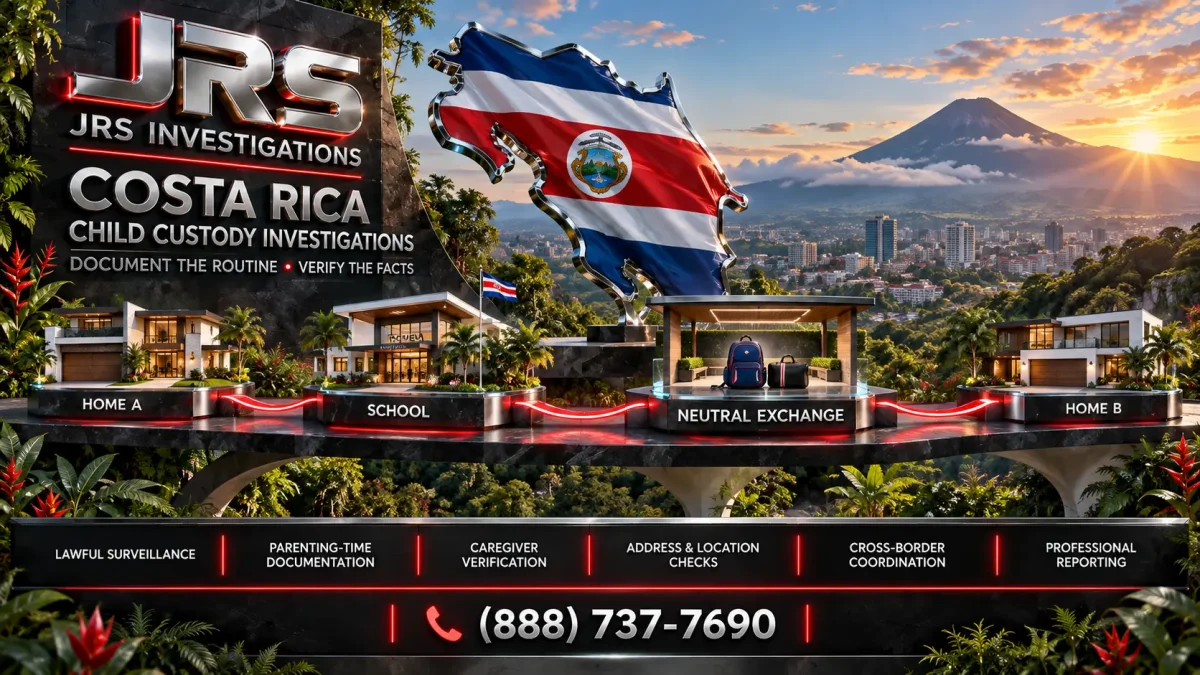
Costa Rica Child Custody Investigator: 5 Reasons
International family cases can become confusing quickly when a child, parent, residence, school and court proceeding are located in different countries. A Costa Rica child custody investigator can help a parent or attorney collect lawful, location-specific facts without turning concern into speculation. JRS Investigations coordinates discreet investigative support in Costa Rica for clearly defined child-custody and family-law objectives.
The investigator does not decide custody, interpret a court order or replace an attorney. The role is to document observable facts, verify relevant information and organize findings so the client and counsel can make informed decisions. Every assignment begins with authority, purpose, location and safety—not assumptions about either parent.
For a confidential consultation, call (888) 737-7690 or contact JRS Investigations. For broader regional capabilities, review our Costa Rica private-investigator services.
Five reasons to hire a Costa Rica child custody investigator
1. Local facts can replace long-distance assumptions
A parent outside Costa Rica may receive incomplete, delayed or conflicting information about a child’s residence, routine or caregivers. Social-media posts and secondhand reports rarely show the full context. A properly scoped investigation can document facts that are observable or lawfully verifiable in Costa Rica at a specific time.
Depending on the circumstances and applicable law, the work may include confirming an address, documenting patterns of arrival and departure from lawful vantage points, identifying adults who appear to provide transportation or care, verifying a claimed workplace or business connection, and noting conditions visible from public areas. The purpose is not to create drama; it is to establish a reliable chronology.
JRS first asks what question the investigation is supposed to answer. “Prove the other parent is unfit” is not an appropriate investigative instruction. “Document who transports the child on specified days” or “verify whether the reported residence is active” is more objective, limited and useful.
2. Professional observation protects the child and the integrity of the case
Child-custody investigations require restraint. An investigator should not confront a child, encourage a child to make statements, manufacture contact, trespass, enter a private residence without permission or interfere with parenting time. Those actions can create safety problems and damage the credibility of the information collected.
JRS plans lawful observation around the client’s documented objective and the access available at the location. Field activity may involve public roads, public businesses or other places where the investigator is legally permitted to be. Notes, photographs and video are tied to dates, times and locations rather than conclusions about what a court should decide.
If the reported concern involves immediate danger, abuse, abandonment or a missing child, emergency services and the appropriate Costa Rican or U.S. authorities may be the correct first call. A private investigation is not a substitute for an emergency response.
3. Caregiver, address and timeline verification can clarify disputed claims
Family cases often involve more than the two parents. Grandparents, partners, household members, drivers, employees or other caregivers may affect the child’s daily environment. A Costa Rica child custody investigator can help verify relevant adult identities and connections using lawful sources and clearly defined criteria.
Potential work may include:
- Residence verification: confirming whether a reported address appears active and documenting facts visible from lawful vantage points.
- Routine documentation: recording observable transportation, exchanges or repeated activities during an agreed period.
- Adult and caregiver research: checking available records and open sources relevant to a specifically identified adult, subject to local law and access restrictions.
- Employment or business verification: confirming an asserted workplace, company or professional connection when it is material to the case.
- Witness or source interviews: speaking with appropriate adults when authorized and when contact will not compromise safety or strategy.
The scope should be proportionate to the legal issue. Broad fishing expeditions, intrusive searches and unsupported accusations waste resources and can expose the client to risk.
4. Cross-border coordination keeps the investigation aligned with counsel
A U.S. custody order does not automatically answer every question in Costa Rica. Different legal systems, languages, privacy rules, local procedures and evidentiary expectations may apply. JRS can coordinate the investigative objective with the client’s attorney and qualified in-country resources so fieldwork supports—not undermines—the legal strategy.
Useful preparation may include the relevant court order, names and photographs for identification, known addresses, vehicle information, a concise chronology and the exact question counsel needs answered. Documents should be shared securely and only with people who need them for the assignment.
International parental-child-abduction matters require particular care. The U.S. Department of State reports that Costa Rica and the United States are treaty partners under the Hague Abduction Convention and encourages parents to contact the Office of Children’s Issues about possible Convention remedies. Its Costa Rica international parental child-abduction guidance also warns against attempting to remove a child without appropriate legal advice and authority.
5. Organized reporting helps attorneys evaluate what the facts support
A useful investigation is documented in a form that can be reviewed. JRS organizes material observations into a chronology and distinguishes direct observation from information supplied by the client or another source. Depending on the assignment, the file may include time-and-location notes, photographs, video, identifiers, source information and a narrative report.
Documentation is not automatically admissible merely because an investigator collected it. Courts and attorneys determine relevance, authentication, disclosure and admissibility. JRS therefore avoids promising a particular legal outcome and recommends that counsel define the objective before fieldwork begins.
Clear reporting also helps identify limits. If the subject was not observed, access was restricted or a fact could not be independently confirmed, the report should say so. An honest limitation is more valuable than an exaggerated conclusion.
What services may be included?
A Costa Rica child-custody investigation may include lawful surveillance and activity documentation, residence or address verification, adult-caregiver research, locate work, employment or business verification, appropriate witness interviews, open-source research and professionally organized reporting. The exact combination depends on the legal objective, location, schedule, safety considerations and local requirements.
JRS can also coordinate related child-custody and domestic-investigation support and other private-investigation services. Each service requires its own lawful scope; one authorization does not permit unlimited access to property, accounts, records or communications.
What an investigator cannot do
- Decide who should receive custody or predict what a judge will order.
- Provide Costa Rican or U.S. legal advice unless separately qualified to do so.
- Enter a home, school, vehicle or private property without lawful permission.
- Hack accounts, intercept private communications or obtain protected records through deception.
- Question, pressure or stage contact with a child to generate evidence.
- Enforce a custody order, seize a child or conduct a cross-border recovery operation.
- Guarantee that evidence will be admitted or that the case will have a particular outcome.
When a case involves service of legal documents, depositions, official records or other formal judicial assistance, counsel should review the U.S. Department of State’s Costa Rica judicial-assistance information and obtain advice from qualified attorneys in the relevant jurisdictions.
How the JRS process works
- Confidential intake: The client explains the family situation, locations, safety concerns and current court status.
- Authority and legal objective: JRS identifies who is retaining the investigator, what counsel needs and what the investigation may lawfully address.
- Focused plan: The team defines subjects, locations, dates, access limits, reporting expectations and communication protocols.
- Coordinated fieldwork: Appropriate resources conduct the agreed activity with discretion and without interfering with the child or family.
- Quality-controlled reporting: Observations and supporting material are reviewed, organized and delivered through an agreed secure channel.
- Attorney-guided next step: The client and counsel decide how, whether and where the information should be used.
Information to prepare before the consultation
Bring the current order or agreement if one exists, the full legal names of relevant adults, recent photographs for identification, known addresses, vehicle information, important dates, a short timeline and the attorney’s contact information. Separate what you personally know from what someone else reported. Do not access another person’s account or device to gather material for the investigator.
If there is an active emergency, abduction concern or imminent international travel, say so at the beginning of the call. Those facts may change which authority or attorney must be contacted first.
Frequently asked questions
Can JRS prove that the other parent is unfit?
No investigator decides parental fitness. JRS can document specified facts within a lawful scope. Attorneys and courts evaluate what those facts mean under the applicable law.
Will the investigator interview my child?
Not as a routine investigative tactic. Contact with a child can create safety, ethical and evidentiary concerns. Any proposed child interview should be directed by qualified counsel and handled by an appropriate professional.
Can a U.S. custody order be enforced directly in Costa Rica?
Do not assume that it can. The legal effect and enforcement process should be evaluated by attorneys familiar with the relevant U.S. jurisdiction and Costa Rican law.
Can JRS retrieve a child from Costa Rica?
No. JRS does not conduct self-help child recoveries or remove a child. Parents facing a possible wrongful removal or retention should contact qualified counsel and the appropriate central authorities promptly.
How long will the investigation take?
Timing depends on the question, location, subject’s routine, legal coordination and the number of observation periods or verifications required. JRS discusses a focused plan and budget before work begins.
Schedule a confidential Costa Rica case consultation
For discreet, objective support in a cross-border family matter, call JRS Investigations at (888) 737-7690 or use the confidential contact form. A clear legal objective, lawful scope and honest reporting are the foundation of every Costa Rica child-custody investigation.