(888) 737-7690
Asheville Workers’ Compensation Investigations: Evidence Guide
An Asheville workers’ compensation investigator can help insurers, employers, third-party administrators, and attorneys evaluate a claim through objective, lawful documentation. JRS Investigations conducts focused investigations throughout Asheville and western North Carolina. Our role is to gather facts, preserve context, and report limitations—not to assume that every claim is fraudulent or to interfere with legitimate benefits.
A useful investigation begins with a defined question. The issue may involve reported physical restrictions, undisclosed work, the circumstances of an accident, a relevant witness, prior public records, or a recurring activity pattern. The investigative plan should match the question, the available information, and the value of the claim.
What a workers’ compensation investigation can address
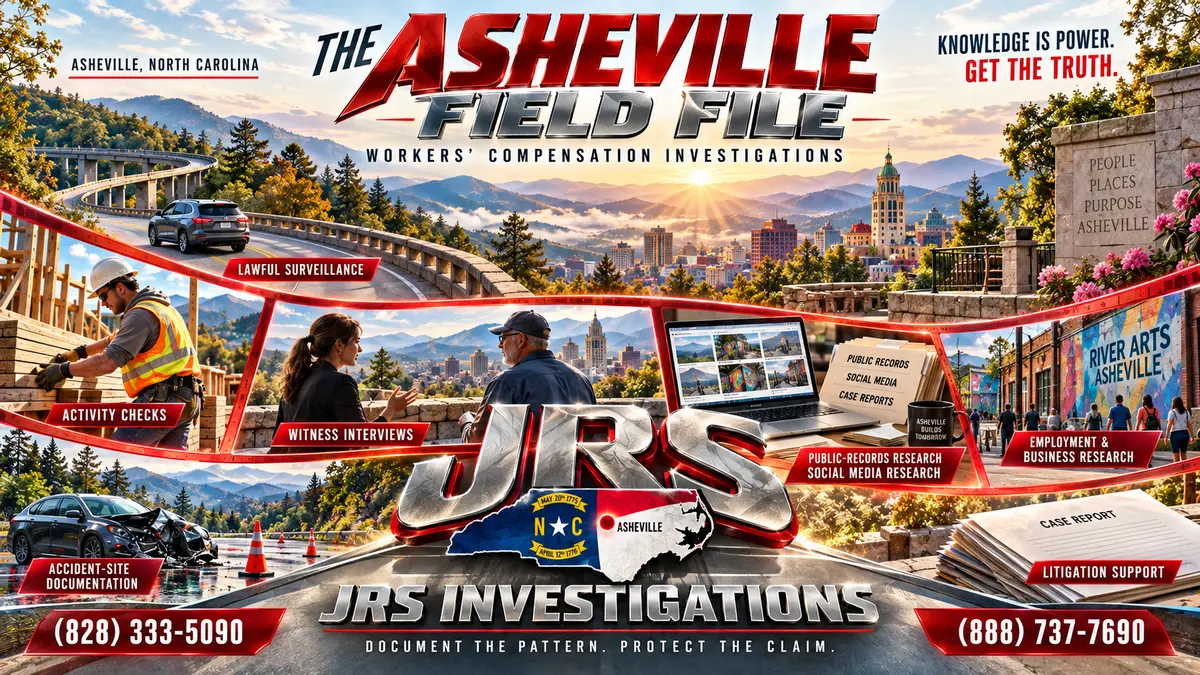
Depending on the assignment and the client’s authority, JRS may assist with:
- Lawful surveillance of publicly visible activity.
- Activity checks and address verification.
- Employment, business, and public-record research.
- Open-source and public social-media research.
- Witness identification and professional interviews.
- Accident-site documentation and neighborhood canvasses.
- Vehicle, property, and corporate affiliation research.
- Chronological reports with properly preserved photographs and video.
Each method should connect to a legitimate issue. Broad, indefinite monitoring wastes resources and can produce material that has little relevance. JRS recommends a clear starting scope and requests authorization before expanding the work.
Five reasons to hire JRS for an Asheville workers’ compensation case
1. Objective activity documentation
Surveillance can document how a person moves and what activities are visible from lawful public vantage points. The report may note walking, lifting, bending, driving, shopping, yard work, recreational activity, or the use of mobility aids. An isolated movement does not prove medical capacity or fraud. Duration, repetition, apparent difficulty, breaks, assistance, and the investigator’s uninterrupted observation all matter.
A professional report avoids medical conclusions. If a claimant carries an object, the investigator should describe the object, distance, method, and observable effort rather than guess its weight or diagnose what the person can do at work. If visual contact is lost, that gap belongs in the report.
2. Local knowledge and realistic coverage planning
Asheville presents terrain and travel conditions that can affect surveillance. Mountain roads, steep driveways, limited shoulders, downtown parking, tourist traffic, gated properties, dense neighborhoods, weather, and movement between Asheville, Arden, Fairview, Weaverville, Black Mountain, and Hendersonville can change the plan.
Local planning helps select lawful observation areas and realistic travel windows. It also reduces the risk of conspicuous positioning. Investigators do not trespass, enter restricted property, create a traffic hazard, or use private property without permission.
3. Public-record and employment research
Research may help verify an address, business interest, professional license, court filing, property connection, or possible employment lead. Public records can provide direction, but a name match is not automatically proof that two records concern the same person. Identifiers, dates, and source reliability must be checked.
JRS does not obtain protected medical, banking, tax, or employment records through deception. Confidential records used to shape the investigation should come from an authorized client, attorney, insurer, administrator, or lawful source.
4. Witness interviews and accident facts
Coworkers, supervisors, customers, contractors, or bystanders may have direct information about an accident, job duties, equipment, safety conditions, or statements made near the event. JRS can identify and interview relevant adults without intimidation or coaching. The report distinguishes the witness’s account from facts independently verified by the investigator.
When site conditions remain relevant, investigators may photograph lawful areas, document lines of sight, identify potential cameras, note signage or lighting, and preserve a clear location chronology. JRS does not present accident reconstruction or engineering opinions unless the assignment includes an appropriately qualified specialist.
5. Organized evidence for claim and legal review
Useful work product is more than a folder of clips. JRS organizes dates, observation times, locations, public records, source notes, photographs, video references, and investigative limitations into a chronological report. Original media and metadata are preserved as required. This structure helps adjusters and counsel compare documented activity with the specific issue under review.
An investigator cannot promise that evidence will change a benefit decision or be admitted in a hearing. Those determinations belong to the authorized decision-makers, counsel, and the North Carolina Industrial Commission. Accurate collection and neutral reporting make the evidence easier to assess.
Surveillance standards that protect credibility
Workers’ compensation surveillance must stay lawful, proportionate, and non-confrontational. JRS observes conduct visible from places where the investigator may legally be. We do not trespass, impersonate government officials, provoke activity, harass a claimant, access private accounts, enter a home, or use unlawful tracking methods.
Investigators should also preserve unfavorable or inconclusive facts. If the claimant appears limited, uses assistance, cancels activity, or remains indoors throughout the authorized period, the report should say so. A balanced record is more credible than selective reporting.
Social-media and open-source research
Public online information may identify a business, event, travel pattern, recreational activity, or possible witness. A post must be evaluated carefully. It may be old, reposted, staged, edited, or published by someone else. JRS records the public source, date accessed, visible context, and relevant identifiers rather than treating a screenshot as self-proving.
JRS does not send deceptive connection requests, obtain passwords, bypass privacy settings, or access private accounts without proper authorization. The objective is evidence preservation, not online confrontation.
North Carolina workers’ compensation fraud context
North Carolina General Statute 97-88.2 addresses willful material false statements made to obtain or deny a workers’ compensation benefit or payment. The statute applies to misconduct that can occur on different sides of a claim. An investigation therefore should test a defined concern fairly rather than begin with a predetermined conclusion.
The North Carolina Industrial Commission’s Criminal Investigations and Employee Classification Division investigates potential criminal violations of the Workers’ Compensation Act, including suspected claimant fraud, employer coverage violations, and employee misclassification. A private investigator does not replace the Commission, law enforcement, counsel, or the claim-administration process.
Current law and procedure can change. JRS provides investigative services, not legal advice. Clients should consult qualified North Carolina counsel about reporting duties, discovery, admissibility, benefit decisions, and case strategy.
Information that improves the investigation
Before fieldwork, an authorized client should provide only the information relevant to the assignment. Useful items may include:
- The claimant’s verified identity and current photograph.
- Known addresses, vehicles, employment leads, and routine locations.
- The date of injury and clearly stated investigative issue.
- Reported restrictions or claim information the client is authorized to share.
- Known appointments, hearings, events, or lawful activity leads.
- Prior investigative results and dates already covered.
- Reporting deadlines, litigation holds, and communication instructions.
Strong scheduling information can reduce unproductive coverage, but it should be verified when possible. A rumor or anonymous tip may justify preliminary research, not an unsupported conclusion.
How the JRS process works
- Confidential intake: We confirm the client’s authority, objective, deadline, and the specific concern.
- Case review: JRS evaluates available identifiers, activity information, geography, safety, proportionality, and likely evidentiary value.
- Written plan: We recommend methods, dates, budget, reporting expectations, and practical limitations.
- Investigation: Fieldwork and research are conducted discreetly within the authorized scope.
- Quality control: Notes, media, sources, and times are reviewed for accuracy and continuity.
- Reporting: The client receives an organized account of findings and limitations. Significant developments can be communicated under the agreed protocol.
Frequently asked questions
Does one active day prove workers’ compensation fraud?
No. A brief observation may lack medical, vocational, or historical context. Investigators document what occurred and avoid deciding what the activity means legally or medically.
Can JRS follow someone onto private property?
No. Investigators must remain in lawful locations and respect restricted areas and reasonable expectations of privacy. Public visibility does not authorize trespass.
Can surveillance cover several days?
Yes, when additional coverage is authorized and proportionate. Multiple carefully selected periods may help distinguish an isolated event from a recurring pattern. JRS discusses the value and cost before expanding the assignment.
Does JRS offer TSCM bug sweeps in North Carolina?
No. JRS does not offer TSCM or debugging services in North Carolina. This Asheville service is limited to authorized private-investigation work such as surveillance, research, interviews, and evidence documentation.
Asheville and western North Carolina coverage
JRS handles authorized investigations throughout Asheville and nearby western North Carolina communities. Learn more about our Asheville private investigator, surveillance investigation, and Blue Ridge Mountains investigation services.
Discuss an Asheville workers’ compensation investigation
Contact JRS Investigations for a confidential assessment of the claim issue, available information, geographic conditions, and appropriate scope. Knowledge is power. Get the truth. Call our western North Carolina office at (828) 333-5090, call toll-free at (888) 737-7690, or contact JRS Investigations online.