(888) 737-7690

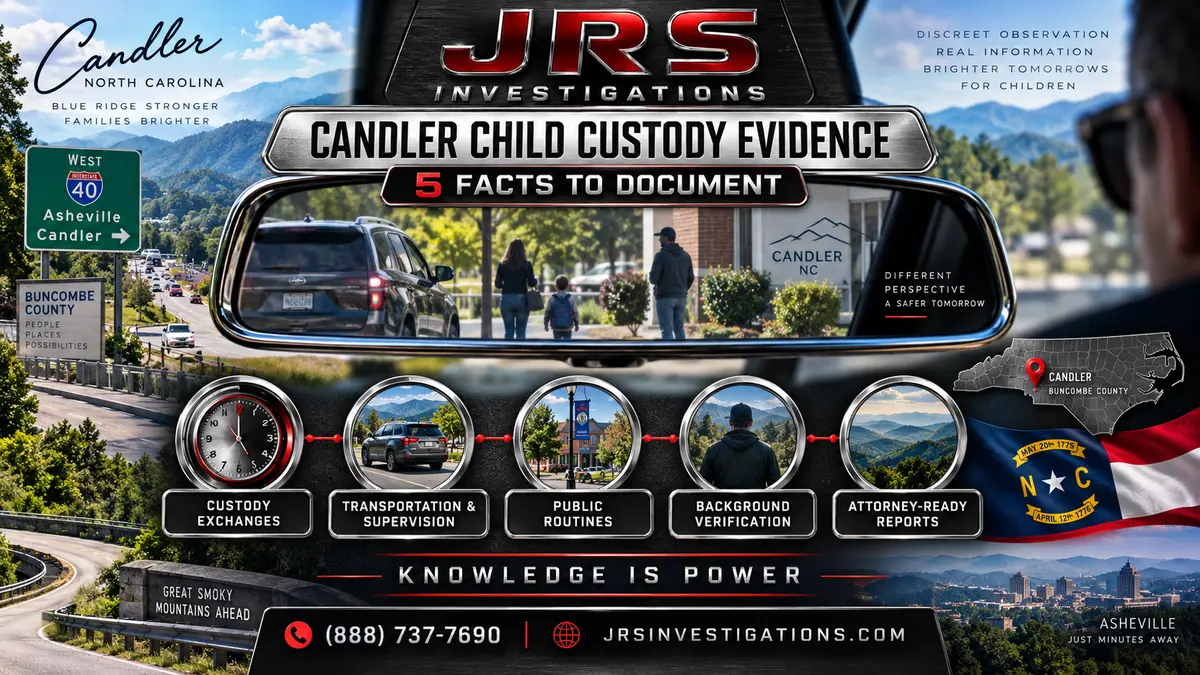
Candler Child Custody Evidence: 5 Facts to Document
When a custody dispute turns on conflicting stories, useful evidence is not a collection of accusations. It is a clear, sourced record of facts that may affect a child’s welfare, schedule, supervision, or safety. A child custody investigator in Candler, North Carolina, can help document those facts through lawful observation, public-source research, and organized reporting.
JRS Investigations serves Candler, Asheville, and surrounding Buncombe County communities. The five evidence categories below are designed to help parents and attorneys focus an investigation on relevant questions instead of emotion or guesswork.
Why custody evidence must stay focused on the child
North Carolina courts decide custody according to the child’s best interests. State law directs judges to consider all relevant factors, including domestic violence and the safety of the child and either party. The court—not the investigator—decides what facts matter, whether evidence is admitted, and what custody arrangement is appropriate.
A responsible investigation therefore starts with a defined question. It does not attempt to diagnose a parent, manufacture conflict, or collect every possible detail about someone’s private life. The goal is to document observable conduct and verifiable information that the client and legal counsel can evaluate.
1. Custody exchanges and parenting-schedule compliance
Repeated problems at custody exchanges can be difficult to prove when each parent remembers the event differently. An investigator may document dates, times, locations, arrivals, departures, missed exchanges, recurring delays, or the presence of relevant adults when those observations are lawful and within the agreed scope.
The value comes from a consistent chronology. One late arrival may have an innocent explanation. A documented pattern across several scheduled exchanges may provide more useful context. The report should separate what the investigator personally observed from information supplied by the client.
2. Transportation and supervision patterns
A focused assignment may examine whether a child is transported or supervised in a manner relevant to the existing parenting plan or a specific concern raised by counsel. Depending on the facts, lawful observation may document vehicle movements, pickup and drop-off routines, adult supervision in public places, or recurring transitions between residences and activities.
An investigator should not assume that an unfamiliar driver, vehicle, or address proves misconduct. Identifiers must be checked carefully, and conclusions should remain limited to what the evidence supports. JRS does not install unauthorized tracking devices, enter private property, or interfere with a parent’s time with the child.
3. Observable routines and public conduct
Courts may receive competing descriptions of a parent’s routine, judgment, or ability to provide care. A professional investigator can document conduct visible from lawful public locations without intruding into private spaces. This may include recurring public activities, relevant travel, the condition of publicly visible areas, or behavior connected to a clearly defined safety or supervision concern.
Surveillance should be proportionate. It should not become an open-ended effort to monitor every aspect of a family’s life. The most efficient plan targets dates and time windows tied to the actual concern, preserves accurate notes, and reports periods when no relevant activity was observed.
4. Relevant adults and public-source verification
When another adult regularly participates in transportation, supervision, or household routines, limited background and public-source research may help confirm identity, addresses, business connections, or publicly available court information. Any research must have a legitimate purpose and remain within privacy, licensing, and access restrictions.
A name match alone is not enough. Common names, old addresses, and incomplete databases can produce errors. Professional research uses multiple identifiers and clearly labels uncertainty. JRS does not hack accounts, obtain protected financial or medical records, impersonate another person, or promise access to information that requires legal process.
5. A sourced chronology for attorney review
Evidence is more useful when it is organized. A professional report may combine time-stamped field notes, photographs or video obtained lawfully, source references, and a clear explanation of what was—and was not—verified. Original files should be preserved, and significant edits or enhancements should be identified.
The investigator can coordinate with counsel when authorized, clarify the report, and provide supporting materials. No private investigator can guarantee that a judge will admit or rely on a particular item, promise a custody outcome, or replace legal advice. The attorney determines how investigative findings fit the case strategy.
Local planning for Candler and Buncombe County
Candler’s position west of Asheville creates practical field considerations. Smokey Park Highway, Interstate 40, neighborhood roads, rural properties, mountain weather, school and activity schedules, and traffic moving toward Asheville can all affect timing and visibility. A local plan should account for lawful observation points, route changes, limited shoulders, private roads, and the difference between a temporary stop and a recurring pattern.
For broader local information, visit the Candler private investigator page. Parents comparing investigative options can also review five reasons to hire a Candler child custody investigator and the separate guide explaining what to expect during a custody investigation.
North Carolina custody and child-safety resources
The North Carolina Judicial Branch child custody guide explains custody terminology, filing, mediation, court procedures, enforcement, and modification. North Carolina General Statute § 50-13.2 addresses the child’s best interests and welfare, including safety and domestic-violence considerations.
If a child may be in immediate danger, call 911. People who suspect abuse or neglect should contact the appropriate county Department of Social Services, as directed by North Carolina Child Protective Services. A private investigation is not a substitute for emergency services, child-protection reporting, or legal counsel.
Information to prepare before the consultation
- The current custody order or parenting plan, if one exists
- A short, date-based summary of the specific concern
- Accurate names, recent photographs, addresses, vehicles, and schedules
- Original messages, public posts, or files that may help define the timeline
- The dates and time windows most likely to answer the investigative question
- Your attorney’s contact information, if you are represented
Do not confront the other parent about planned surveillance, follow the subject yourself, question the child for investigative purposes, enter private property, access private accounts, or place a tracking device. Those actions may create safety, privacy, and evidentiary problems.
Frequently asked questions
Can an investigator decide whether a parent is unfit?
No. An investigator documents facts within the lawful scope of the assignment. The court makes custody findings, and qualified professionals address legal or clinical questions within their own roles.
Will surveillance prove every concern?
No. Surveillance may confirm a pattern, contradict an allegation, or produce no relevant activity during the scheduled period. Accurate negative findings are still part of a neutral report.
Can JRS interview the child?
JRS does not question or approach a child casually during surveillance. Any child interview requires careful legal authority, case-specific planning, and coordination with counsel or the appropriate professional.
How many hours are needed?
The answer depends on the question, schedule, travel, location, and whether the suspected conduct is recurring. A focused plan built around high-value time windows is usually more useful than unfocused monitoring.
How do I start?
Review JRS child custody and domestic investigation services, then request a confidential case review through the contact page or call (888) 737-7690.
Request a confidential Candler case review
JRS Investigations can help define a lawful, child-focused investigation plan for Candler and the greater Asheville area. We will discuss the specific question, available information, likely field conditions, reporting needs, and realistic limitations before work begins.
Call JRS Investigations 24/7 at (888) 737-7690.
This article provides general information and is not legal advice. Investigative services are subject to applicable law, licensing requirements, conflict checks, and case-specific limitations.