(888) 737-7690
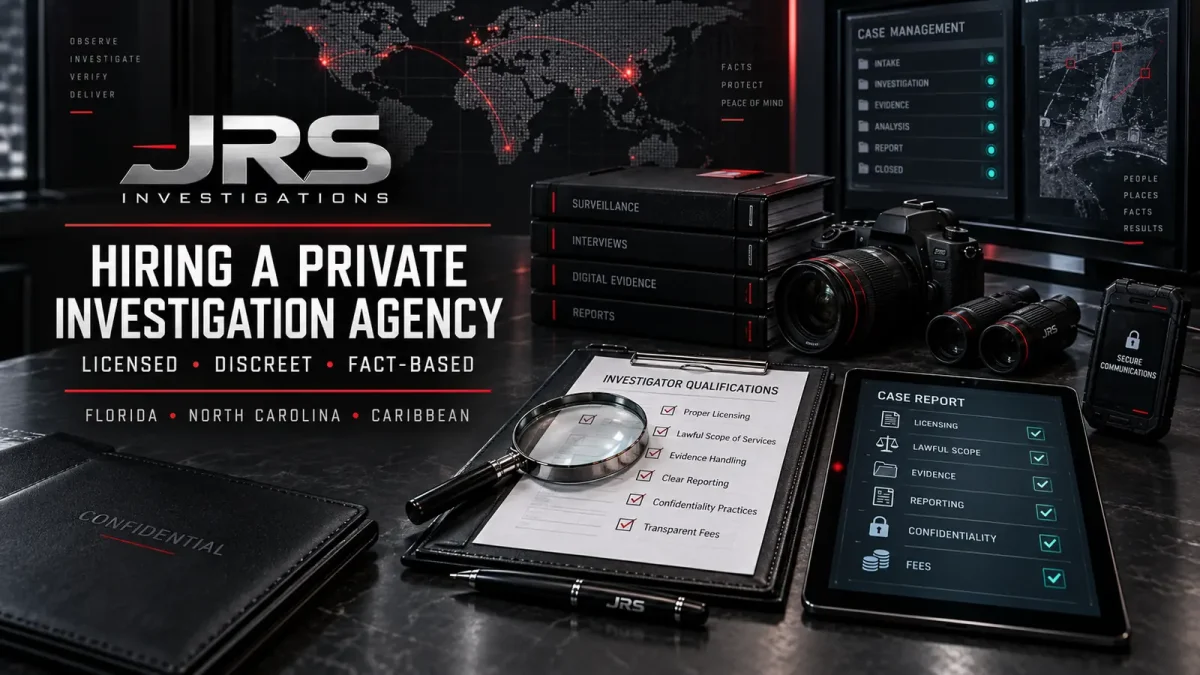
How to Hire a Good Private Investigation Agency
Hiring a private investigation agency usually begins with a problem that is sensitive, urgent, or difficult to verify independently. You may need facts for a legal matter, clarity about a personal concern, information about a business relationship, help locating someone, or documentation that can support an informed decision. The agency you choose can affect the quality, legality, usefulness, and confidentiality of the work.
A good investigator does more than promise answers. The investigator defines the question, explains what can lawfully be done, recommends a realistic plan, documents the work, and distinguishes verified facts from assumptions. Before retaining any firm, evaluate its licensing, relevant experience, methods, fees, communication, and reporting standards.
Define What You Need to Learn
Begin with the decision the investigation must support. “Find out everything” is rarely an efficient assignment. A focused objective helps the investigator select appropriate methods, estimate time and cost, and explain likely limitations.
For example, your objective may be to:
- Document activity relevant to an infidelity, cohabitation, custody, or insurance matter
- Verify a person’s identity, background claims, employment, education, or business interests
- Locate a witness, family member, debtor, heir, or other lawful subject
- Identify public-record leads involving real estate, companies, liens, judgments, or assets
- Investigate suspected fraud, employee misconduct, theft, or conflicts of interest
- Assess concerns involving physical surveillance, hidden devices, cameras, transmitters, or trackers
The agency should ask why the information is needed, who the subject is, where relevant events occurred, what documentation already exists, and whether an attorney or court deadline is involved. Those questions are a sign of careful scoping, not unnecessary delay.
Verify the Agency and Investigator Licenses
Licensing requirements vary by state and country. Confirm both the agency’s authority to offer investigative services and the credentials of the investigator responsible for the work. Ask for the license number, issuing authority, legal business name, and location covered by the license. Then verify that information with the regulator rather than relying only on a website badge or business card.
In Florida, the Florida Department of Agriculture and Consumer Services licenses and regulates private investigative agencies and individual investigators under Chapter 493. Florida uses different classifications for agencies, branch offices, investigators, interns, managers, and armed duties.
In North Carolina, the Private Protective Services Board administers licensing requirements for private protective services. Its guidance explains that a firm operating lawfully in North Carolina must employ a license holder designated as its qualifying agent.
Do not assume that authority in one state automatically permits work in another. Interstate and international cases may require reciprocity, temporary authority, locally licensed investigators, counsel, or another lawful arrangement. A professional agency should explain who will perform each part of the assignment and under what authority.
Match Experience to the Assignment
Years in business can be relevant, but the more important question is whether the agency has experience with your type of case. Surveillance, background research, missing-person investigations, technical surveillance countermeasures, fraud inquiries, digital forensics, and executive protection require different skills and tools.
Ask the investigator to describe the process used in similar matters without revealing another client’s identity or confidential details. A useful answer should explain the approach, common obstacles, expected documentation, and limits. Be cautious when a provider shares private client information as a sales tactic. That behavior may show how your own information will be treated.
Review the firm’s investigation services and look for clear descriptions of methods and limitations. If the matter involves personal history, business relationships, or due diligence, ask how the agency’s background-check process fits the legal purpose and available records.
Ask How the Work Will Be Performed Lawfully
A license does not make every requested action legal. Investigators must work within privacy, trespass, recording, data-access, impersonation, tracking, and other applicable laws. The rules may change across jurisdictions and case types.
A credible investigator should decline requests involving unauthorized account access, illegal recordings, fabricated identities used to obtain protected information, unlawful entry, or other improper conduct. The agency should also ask whether you have legal authority to request certain records or inspect a residence, office, device, account, or vehicle.
If evidence may be used in litigation, tell the investigator at the beginning. Your attorney may need to help define relevance, privilege, preservation, or testimony requirements. Investigators gather and document facts; they do not replace legal counsel or determine the ultimate legal outcome.
Evaluate Evidence and Reporting Standards
Ask what the final work product will contain. Depending on the assignment, a report may include dates, times, locations, observations, source descriptions, photographs, video, public-record results, interview summaries, and a clear explanation of limitations.
Good reporting separates direct observations from third-party statements and database leads. A database match is not automatically proof that information is current or belongs to the correct person. Important findings may require confirmation through primary records, additional identifiers, surveillance, interviews, or other lawful methods.
When photographs or video are expected, ask about timestamps, original files, storage, delivery, and retention. When a witness interview is involved, clarify whether the investigator will prepare notes, a written statement, an audio or video recording where lawful, or a formal report. If testimony may be required, discuss availability and fees in advance.
Protect Confidentiality From the First Contact
Private investigations often involve personal relationships, children, finances, litigation, health concerns, travel, businesses, or security issues. Ask how the agency protects intake information, case files, recordings, reports, passwords, itineraries, and communications.
Confirm who will have access to the case and whether subcontractors or local investigators may be involved. Sensitive information should be shared only with personnel who have an operational need. If you are represented by counsel, ask whether communications and reports should be routed through the attorney.
Confidentiality also requires judgment from the client. Avoid discussing the investigation with the subject or posting about it online. Do not alter potential evidence, create confrontations, or begin your own surveillance after hiring the agency unless the investigator and counsel advise that a particular step is appropriate.
Understand Fees, Retainers, and Expenses
Investigation costs depend on the service, location, urgency, expected duration, travel, equipment, records, staffing, reporting, and court requirements. Some work may be quoted at a fixed price. Other assignments use an hourly rate against a retainer.
Before authorizing work, request a written agreement that explains:
- The objective and authorized scope
- Hourly rates or fixed fees
- The retainer and replenishment terms
- Mileage, travel, lodging, records, equipment, and other expenses
- Minimum billable time and cancellation terms
- Report, media, testimony, and court-appearance fees
- How material scope changes will be approved
The lowest price is not always the best value, but a high price does not prove quality. Compare the proposed method, supervision, documentation, relevant experience, and realistic chance of answering the defined question.
Set Communication Expectations
Ask who will be your primary contact, how often updates will be provided, and how urgent decisions will be handled. Surveillance and field investigations can change quickly. Weather, subject movement, access, travel, or new facts may alter the original plan.
Good communication does not mean constant live updates that distract the investigator or compromise the assignment. It means agreed reporting intervals, a way to reach the case manager when necessary, and prompt notice when additional authorization is required.
The agency should also explain what it cannot predict. An investigator cannot guarantee that a subject will appear at a certain location, that a particular asset exists, that a hidden device will be found, or that every database will contain current information.
Review Geographic Coverage and Local Resources
A case may begin in one location and lead elsewhere. Ask whether the agency works directly in the relevant jurisdiction, has lawful reciprocity, or coordinates with properly licensed local resources. Confirm who supervises the work and whether the written agreement covers outside investigators and expenses.
JRS Investigations serves clients in Florida and North Carolina and evaluates authorized assignments across the Caribbean and other locations. Availability depends on the service, licensing, local law, travel, timing, and qualified resources. Our About JRS Investigations page explains the agency’s approach and service footprint.
Warning Signs When Hiring an Investigator
Pause before hiring a provider that:
- Guarantees a specific result before reviewing the facts
- Will not provide verifiable licensing information
- Suggests hacking, unlawful recording, trespass, or unauthorized tracking
- Uses fear or pressure to sell unnecessary services
- Refuses to provide a written agreement or clear fee structure
- Makes unsupported claims about law-enforcement access or secret databases
- Cannot explain how findings will be documented
- Shares confidential details about other clients
- Promises that all work can be performed across state or national borders without local requirements
Questions to Ask During the Consultation
- Are the agency and assigned investigator licensed for this location and service?
- What experience do you have with this type of matter?
- What information do you need from me before recommending a plan?
- Which methods are appropriate, and what legal or practical limits apply?
- What is the estimated cost, and which expenses are separate?
- How will I receive updates, evidence, and the final report?
- Who will have access to my case information?
- Will another investigator, specialist, or local partner be involved?
- What circumstances could change the scope, timing, or budget?
- Are testimony or attorney coordination available if needed?
Prepare for a Productive Initial Consultation
Organize the known facts before the call. Prepare a short timeline, correct names and identifiers, relevant addresses, photographs, documents, court dates, vehicle information, and examples of concerning communications. Label what you personally observed and what another person reported.
Explain the result you need, the deadline, and the available budget. Do not send highly sensitive records until you have verified the agency and agreed on a secure delivery method. If there is an immediate threat or emergency, contact 911 or the appropriate local emergency service before seeking private investigative assistance.
How JRS Investigations Approaches New Cases
JRS begins with a confidential consultation to understand the facts, objective, jurisdiction, timing, and intended use of the information. We identify realistic investigative options, explain limitations, and recommend a scope suited to the case. Work begins only after the client authorizes the agreement and required retainer or fee.
As the investigation develops, we document relevant findings and communicate material changes that may affect the plan. When a matter requires counsel, a different license, digital forensics, cybersecurity, or another specialist, we explain that boundary rather than presenting one service as a solution to every problem.
Private Investigation Agency FAQs
Can a private investigator guarantee results?
No responsible investigator should guarantee a particular finding. The agency can explain its process, effort, reporting, and likely obstacles, but the facts and subject’s actions cannot be controlled.
Should I hire the closest investigator?
Local knowledge can help, but specialization, licensing, lawful authority, supervision, and reporting quality are equally important. A well-managed agency may coordinate qualified resources in another location when the law permits.
Will the subject know an investigation is occurring?
Many assignments are designed to be discreet, but invisibility cannot be guaranteed. Legal notices, interviews, records requests, environmental conditions, or the subject’s awareness may affect confidentiality.
How quickly can an investigation start?
That depends on the service, location, investigator availability, legal authority, required preparation, and urgency. Early contact provides more time for planning, especially when surveillance, travel, court deadlines, or specialist equipment is involved.
How do I contact JRS Investigations?
Use the confidential contact form or call (888) 737-7690. Provide the general location, objective, deadline, and whether an attorney is involved. JRS will evaluate the request and explain appropriate next steps.
Choose an Agency That Explains the Work Clearly
A good private investigation agency will not sell certainty where none exists. It will verify legal authority, define a focused objective, use methods appropriate to the assignment, protect confidential information, document findings, and communicate when the facts require a change in strategy.
Take time to verify credentials and compare written scopes. The right agency should help you understand not only what it proposes to do, but why that work is lawful, relevant, and reasonably designed to answer your question.