(888) 737-7690
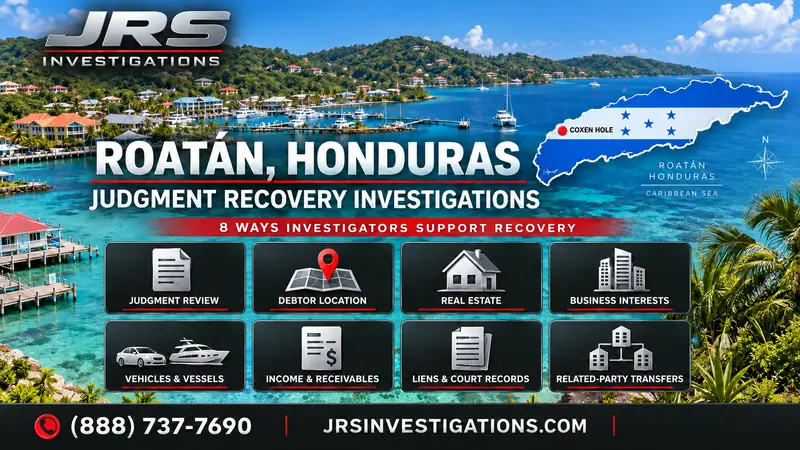
8 Ways Investigators Support Judgment Recovery in Roatán, Honduras
A court judgment is an important legal result, but it does not automatically identify property, locate a debtor or produce payment. When a debtor or asset has a connection to Roatán, the Bay Islands or mainland Honduras, a focused Roatán Honduras judgment recovery investigation can help counsel develop reliable leads before taking an enforcement step.
JRS Investigations supports attorneys, judgment creditors, businesses and individuals with lawful debtor-location and asset research. The investigative role is to find and document information. Recognition of a foreign judgment, attachment, seizure, garnishment and other enforcement remedies must be evaluated and pursued by qualified Honduran counsel through the proper court.
Important limitation: JRS does not have unrestricted access to private bank balances, transactions, credit files, tax returns or investment statements. Those records generally require the subject’s authorization or valid legal process. JRS does not use hacking, pretexting or unauthorized account access.
8 ways investigators can support judgment recovery in Roatán
1. Confirm the judgment, debtor and enforcement objective
The first step is to confirm exactly who owes the judgment, the court that issued it, the amount and date, whether interest or costs apply, and whether an appeal or stay affects enforcement. Names, company numbers, aliases and addresses should match the judgment documents. A similar name is not enough to connect an asset to a debtor.
When the judgment was entered outside Honduras, local counsel should determine whether recognition or another judicial procedure is required before Honduran assets can be reached. The Judicial Branch of Honduras electronic-services portal provides access points for judicial information, while the court and counsel determine the correct procedural route. JRS organizes the investigative evidence; it does not provide Honduran legal advice or promise a recovery outcome.
2. Locate and identify the debtor
A current location can be essential for service, examination, negotiation or attorney-directed proceedings. Investigators may compare lawful address history, telephone and email identifiers, public business activity, professional information, litigation records and documented relationships. In Roatán, a subject may use a property name, development, business address or mailing contact rather than a conventional street address.
JRS distinguishes confirmed information from possible leads. Social-media content, a shared address or a sighting at a resort does not by itself prove residence, ownership or employment. Important findings are corroborated before they are used in a report. Our Roatán private investigations page explains broader local coverage.
3. Research real estate and land interests
Homes, vacation properties, rental units, development lots, commercial buildings and beneficial interests in real estate may be relevant to a recovery strategy. Research can connect names, entities, parcel information, recorded instruments, liens, addresses and transaction history. It can also identify questions for a formal title search or court-authorized discovery.
Honduras’s Instituto de la Propiedad administers property, vehicle, intellectual-property and related registry functions. Registry research should be confirmed through the appropriate office and current certified records. A public lead or cadastral reference is not a title opinion, proof of available equity or authorization to seize property.
4. Identify companies and business interests
A debtor may hold value through a corporation, partnership, tourism business, rental operation, management company, vessel-related enterprise or other entity. Investigators can compare public registrations, trade names, officers, addresses, websites, licensing information, litigation and relationships among companies. The objective is to document connections that counsel can evaluate, not to assume that every affiliated company belongs to the debtor.
Roatán’s economy includes lodging, real estate, marine services, restaurants, diving, construction and other tourism-related businesses. Commercial activity may create receivables or ownership interests even when a person’s name is not prominent on public advertising. JRS’s due diligence investigations can assist when the work also involves a proposed transaction or business relationship.
5. Develop vehicle, vessel and other titled-asset leads
Vehicles, boats, commercial equipment and other titled property may carry value or reveal additional addresses and business connections. Investigators may use lawful registry information, recorded liens, public photographs, marina or commercial information, observations and documents supplied by the client. Availability depends on the record, jurisdiction and requester’s authority.
A vehicle parked at a residence or a boat shown online should be treated as a lead until ownership is verified. Financing, liens, shared ownership, lease arrangements and exemptions can affect whether an identified asset has recoverable value. Local counsel and qualified valuation professionals may need to examine those issues.
6. Identify lawful income and receivable leads
Employment, contract work, rental activity, management fees, business receivables and other documented income sources may matter in a collection strategy. Public commercial activity, professional information, court filings, business websites, property rentals and contracts provided by the client can help identify possible payors or revenue streams.
Investigators cannot simply pull payroll records, account balances or payment histories. Exact income and payment details may require consent, subpoenas, discovery or a court order. The Honduras National Banking and Insurance Commission explains that confidential credit information is provided to the person it concerns or a properly authorized representative. This is why JRS focuses on lawful public records and attorney-directed process.
7. Review court matters, liens and competing claims
An apparent asset may already be subject to a mortgage, lien, secured claim, tax obligation, lawsuit, bankruptcy-related issue or another judgment. Court and registry research can help determine whether a lead is worth additional legal expense. The existence of property does not establish that equity is available to satisfy a particular creditor.
Investigators review names, case identifiers, filing dates, parties, dispositions and available documents. Counsel should confirm priority, limitation periods, exemptions and enforcement procedure. JRS’s judgment recovery investigations service provides related investigative support for attorney-led enforcement matters.
8. Document transfers and related-party connections
Property or business interests may be transferred to a relative, associate or related entity before or after litigation. Investigators can compare dates, names, addresses, officers, recorded instruments and the timeline of the dispute. A pattern may help counsel identify records to request or transactions to examine.
A family relationship, shared address or company connection is not proof of fraud. JRS reports objective evidence and avoids labeling a transfer improper without sufficient support. Questions about fraudulent conveyance, beneficial ownership or available remedies belong with qualified counsel.
How JRS develops a useful recovery report
A productive report connects sources and explains their limits. Depending on the assignment, work may include:
- Confirming names, aliases, companies and identifying details
- Organizing known addresses and a defensible timeline
- Researching property, entity, court and titled-asset leads
- Comparing related entities, officers and addresses
- Documenting the source and date of each material finding
- Separating verified facts from leads requiring legal process
- Identifying gaps for counsel, a forensic accountant or a valuation expert
Our hidden asset investigations and international asset investigations pages explain how this work may expand when the subject or ownership structure crosses borders.
When records point to more than one owner or jurisdiction, the report should show the chain clearly: the person, the related company, the asset, the source record and the date of the connection. This organization helps counsel decide which leads justify certified documents, formal discovery or further investigation. It also reduces the risk of confusing a business affiliation with legal ownership or treating an outdated filing as current.
Cross-border judgment recovery requires local legal coordination
A United States or other foreign judgment may not be directly enforceable in Honduras without additional court action. The required procedure depends on the issuing court, the judgment, applicable law and the assets involved. JRS can help locate a debtor and develop asset leads, but Honduran counsel must advise on recognition, service, provisional measures, attachment and execution.
Investigative findings should be gathered with the intended legal use in mind. Counsel may need certified copies, translations, authenticated documents or testimony regarding how evidence was obtained. Beginning with a coordinated scope reduces duplicated work and helps preserve a clear source trail.
Information to provide before the investigation begins
Clients can help focus the assignment by providing:
- A complete copy of the judgment and relevant court orders
- The current balance calculation supplied by counsel
- The debtor’s full legal name, aliases and known entities
- Dates of birth or registration numbers when lawfully available
- Known Roatán, Bay Islands and mainland Honduras addresses
- Property, vessel, vehicle or company information already obtained
- The name and contact information of Honduran or enforcement counsel
- The deadline and specific legal objective
Do not send account credentials, unnecessary identity documents or sensitive financial records by ordinary email. JRS can discuss a secure method for case materials.
Roatán and Honduras coverage
Assignments may involve Coxen Hole, French Harbour, West End, West Bay, Sandy Bay and other Roatán communities, as well as Guanaja, Utila and mainland Honduras. Related assets or entities may also connect to Florida, other U.S. states or Caribbean jurisdictions. Visit our Roatán Island private investigator page or review all JRS investigation services.
Request a confidential judgment-recovery consultation
For a lawful Roatán Honduras judgment recovery investigation, call JRS Investigations toll-free at (888) 737-7690 or use our contact page. Explain where the judgment was entered, the known connection to Roatán or Honduras and the assets or entities already identified.
JRS will outline a practical investigative scope and explain which findings may be available through lawful research and which records require attorney-directed legal process. No ethical investigator can guarantee that every asset will be found, that an asset is reachable or that a judgment will be collected.