(888) 737-7690
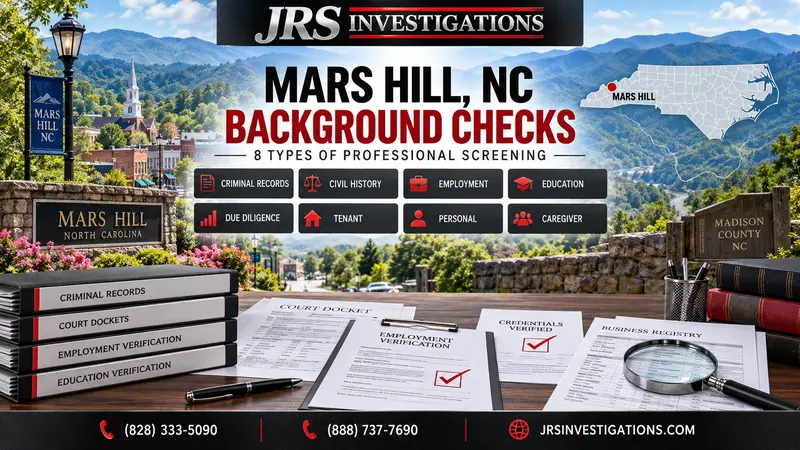
8 Types of Background Checks in Mars Hill, NC
A reliable background investigation is more than a quick name search. Records may be incomplete, belong to another person or lack the context needed for a sound decision. Professional Mars Hill NC background checks combine lawful research, source verification and clear reporting so clients can understand both what was found and what could not be confirmed.
JRS Investigations assists individuals, attorneys, businesses, property owners and families in Mars Hill and across Western North Carolina. Each assignment begins with a legitimate purpose and an agreed scope. The type of information that may be collected or used depends on the case, the client’s legal authority and applicable privacy, employment, housing and consumer-reporting laws.
Compliance matters: Employment and tenant screening can trigger federal and state requirements, including consent, disclosure and adverse-action procedures. This article is general information, not legal advice. Employers and housing providers should consult qualified counsel about their specific process.
8 types of background checks in Mars Hill, North Carolina
1. Criminal court-record research
Criminal-record research can identify publicly available cases associated with a subject’s name and other matching identifiers. A careful review distinguishes pending charges from convictions, confirms the court and jurisdiction, and checks whether the record reasonably belongs to the correct person. Name-only results can be misleading, especially when people share common names or records contain incomplete identifying information.
The North Carolina Judicial Branch explains several ways to obtain criminal background information. A certified clerk search is limited to a single county, while other authorized options may provide broader access. That distinction is one reason a professional investigation documents the source and geographic scope of every search instead of describing a result as “complete” without qualification.
Learn more about JRS background-check services and how record verification fits within a larger investigation.
2. Civil litigation and court-history checks
Civil records may reveal lawsuits, judgments, liens, evictions, contract disputes or other matters relevant to litigation support, business decisions and due diligence. A civil case filing is not automatically proof that an allegation was true. The parties, claims, disposition and date must be reviewed before the record can be interpreted responsibly.
For attorneys and parties preparing for a dispute, the work may include confirming identities, researching related entities, locating public filings and organizing a chronology. JRS does not use a background report to “discredit” someone automatically. We report verifiable information and let the client and counsel assess its relevance.
3. Employment-history verification
Employment verification compares information supplied by a candidate or subject with information that can be lawfully confirmed. Depending on the authorization and source cooperation, this may include employer names, job titles, dates of employment and professional responsibilities. It can also reveal gaps or inconsistencies that require a direct, neutral follow-up.
When an employer obtains a background report through a company that compiles information for employment decisions, the Fair Credit Reporting Act may require a standalone disclosure, written permission and specific steps before and after an adverse decision. The Federal Trade Commission’s employment background-check guidance summarizes applicant rights and employer responsibilities.
4. Education and professional-credential verification
Degrees, attendance dates, licenses, certifications and professional standing can be important when a role depends on specialized training or public trust. Verification focuses on the issuing institution or licensing authority rather than relying on a résumé, social profile or uploaded certificate alone.
The scope may include checking whether a credential exists, whether it is current and whether a public disciplinary record is available. Some institutions require written authorization or use third-party verification services. JRS documents those limitations instead of treating a lack of immediate confirmation as evidence of deception.
5. Business and due-diligence investigations
Before a partnership, investment, acquisition or substantial contract, clients may need to know who controls a company and whether the representations made about its history can be supported. Due diligence can examine business registrations, ownership connections, litigation, regulatory records, professional history, media coverage and other lawfully available sources.
Financial research is carefully limited. Private investigators do not have lawful open access to a person’s bank balances or private account records. Asset-related work may identify public real-estate interests, recorded liens, business affiliations or other lawful indicators, while nonpublic financial records generally require consent, a subpoena or another valid legal process.
Our related article on Mars Hill fraud investigations explains how documentation and corroboration can support a suspected-fraud matter.
6. Tenant and residential-history screening
Property owners and managers may use screening to verify identity, prior addresses, rental references, eviction records or other relevant information. The process should apply consistent criteria, protect applicant data and comply with federal, state and local housing and consumer-reporting rules.
A database match should be checked against reliable identifiers before it influences a housing decision. If information from a consumer report contributes to an adverse decision, required notices and dispute rights may apply. JRS can perform authorized investigative work, but the property owner remains responsible for lawful policies and final decisions.
7. Dating, premarital and personal-safety checks
Online relationships can move quickly while leaving important facts unverified. A personal background investigation may help confirm identity, address history, business claims, marital-status indicators, civil or criminal court records and public online activity. The purpose is to identify inconsistencies and provide facts—not to invade a person’s private accounts or guarantee their intentions.
Clients should avoid sending money, account credentials or highly sensitive documents to someone whose identity remains uncertain. JRS uses lawful research methods and will not hack accounts, impersonate another person, install unauthorized tracking software or obtain protected records through deception.
8. Caregiver and household-personnel screening
Families hiring caregivers, household employees or people who will have access to a vulnerable adult may need a more careful review than a single criminal-record search. With appropriate authorization, the scope can include identity, employment, education, credentials, driving history where relevant, references and public court or disciplinary records.
The position’s actual responsibilities should guide the search. A role involving transportation, medication support, finances or unsupervised access may present different risks. Screening is one part of a sound selection process and should be combined with interviews, verified references, clear duties and ongoing supervision.
Why a database search is not the same as an investigation
Aggregated databases can be useful lead sources, but they may contain outdated addresses, duplicate profiles, omitted jurisdictions or records belonging to someone else. A professional investigator treats a database result as a starting point and attempts to corroborate important findings through primary or authoritative sources.
That process may include:
- Confirming the subject’s identity before attributing records
- Searching jurisdictions connected to verified address history
- Reviewing case details and outcomes instead of listing filings without context
- Verifying employers, schools, licenses or business entities at the source
- Separating confirmed facts from unresolved leads
- Reporting search limitations so the client understands the coverage
The goal is a defensible report, not the longest possible list of data points.
Employment background checks require consistent standards
Employers should define job-related screening criteria before reviewing results and apply those criteria consistently. The U.S. Equal Employment Opportunity Commission explains that background information may not be used in a way that unlawfully discriminates against applicants or employees. Medical and genetic information are subject to additional restrictions.
When a third-party background report is used, employers may also have disclosure, authorization, pre-adverse-action and adverse-action duties under the FCRA. JRS can discuss investigative scope and documentation, but employment counsel or a qualified compliance professional should approve the employer’s screening policy and decision workflow.
What JRS needs to start a Mars Hill background investigation
A focused request saves time and reduces the chance of a mistaken match. Be prepared to explain the purpose of the investigation, how the information will be used and what authorization or legal authority applies. Useful information may include:
- The subject’s full legal name and known aliases
- Date of birth or other lawful identifiers when available
- Current and previous addresses or associated jurisdictions
- The specific claims, credentials or history that need verification
- Signed consent when required for employment, tenant or other regulated screening
- Relevant court filings, contracts, résumés or business documents
- The deadline and intended format for the final report
Sensitive identifiers should be transmitted only through an appropriate method after the scope has been discussed.
Local background-check support in Mars Hill
Mars Hill is part of Madison County and is closely connected to Marshall, Weaverville and the greater Asheville area. Local context helps determine which county records, institutions, employers and neighboring jurisdictions may be relevant. Visit our Mars Hill private investigator page for local coverage, or review all areas served.
Background work may support civil litigation, fraud review or a broader criminal investigation, but each service has a different purpose and legal boundary. JRS defines the scope before research begins and reports results with source context and practical limitations.
Request a confidential consultation
For professional Mars Hill NC background checks, call JRS Investigations at (828) 333-5090 or toll-free at (888) 737-7690. You may also use our contact page to request a confidential consultation.
Tell us what decision you are preparing to make and which facts need verification. We will explain the lawful options, likely sources and appropriate next steps.