(888) 737-7690
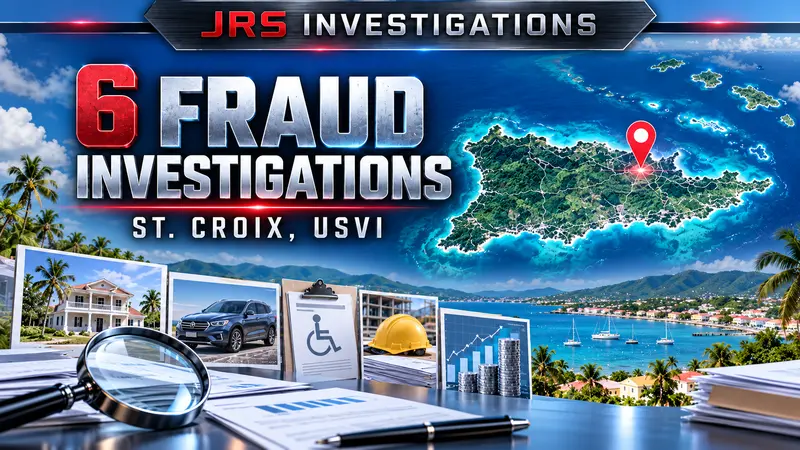
6 Types of Fraud Investigations in St. Croix, USVI
Fraud concerns can arise when a claim, transaction, or reported loss does not match the available facts. In St. Croix, a well-planned private investigation can help attorneys, insurers, businesses, and individuals organize information, identify inconsistencies, and make better-informed decisions.
JRS Investigations provides discreet, case-specific support for St. Croix fraud investigations. Every matter begins with a review of the client’s objectives, the available records, and the lawful investigative options. The goal is not to assume wrongdoing. It is to develop reliable facts and document them clearly.
Below are six common types of fraud-related matters our investigators may assist with in St. Croix and the wider U.S. Virgin Islands.
1. Workers’ compensation investigations
A workers’ compensation investigation may be appropriate when reported limitations, timelines, employment information, or incident details appear inconsistent. Employers, insurers, and counsel may need independent fact-finding before deciding how to handle a claim.
Depending on the circumstances and applicable law, investigative work may include:
- Reviewing the reported incident and claim timeline
- Locating and interviewing relevant witnesses
- Conducting lawful surveillance in public settings
- Reviewing publicly available online information
- Checking for undisclosed business or employment activity
- Preparing a factual written report with supporting documentation
Surveillance findings must be interpreted carefully. A single activity does not necessarily disprove an injury, so observations should be evaluated alongside the broader record and the specific allegations in the claim.
2. General liability claim investigations
General liability matters can involve alleged injuries, unsafe conditions, negligent conduct, or disputed events at a business or property. The central questions often concern what occurred, who witnessed it, whether the account is consistent, and what documentation exists.
An investigator may help identify witnesses, verify timelines, photograph relevant public-facing locations, review accessible records, and compare statements for material inconsistencies. Early action can be important because surveillance video may be overwritten, witnesses may become harder to locate, and physical conditions can change.
3. Property and casualty investigations
Property and casualty claims may involve theft, vandalism, fire, storm damage, damaged equipment, or disputed ownership. Investigative support can help establish a clearer chronology and determine whether available records are consistent with the reported loss.
Useful sources may include photographs, repair records, receipts, ownership information, witness accounts, publicly available records, and other lawfully obtained documentation. Investigators can also help locate people connected to the property or transaction when additional interviews are needed.
4. Disability claim investigations
Disability-related investigations require discretion and a precise scope. The purpose is to document relevant facts, not to make a medical diagnosis. A properly planned investigation may examine whether publicly observable activity, business involvement, or other information appears consistent with representations made in a claim.
JRS approaches these matters with attention to privacy, proportionality, and the client’s legal guidance. Findings are reported factually so that insurers, counsel, or other authorized decision-makers can evaluate them in the appropriate context.
5. Auto liability investigations
Auto liability disputes can involve conflicting accounts of a collision, unidentified witnesses, disputed vehicle use, staged-loss concerns, or questions about injuries and damages. Timely fact development can preserve details that may otherwise disappear.
Investigative steps may include locating witnesses, documenting an accessible scene, verifying identities and addresses, reviewing public records, and organizing photographs or statements supplied by the client. When appropriate, the investigation can also explore connections among parties that may be relevant to a suspected coordinated claim.
6. Subrogation investigations
Subrogation matters focus on identifying responsible parties and developing information that may support recovery after a loss has been paid. A private investigator can assist when a person, business, asset, or current address must be located or when the facts surrounding responsibility remain unclear.
Possible tasks include skip tracing, corporate and public-record research, witness location, ownership research, and documentation of relevant relationships. Investigative findings do not determine legal liability, but they can give insurers and counsel useful leads for further evaluation.
How a St. Croix fraud investigation begins
A productive investigation starts with a defined question. Before fieldwork begins, JRS reviews the known facts, the client’s authority to request the work, the desired outcome, and any deadlines. We then recommend a proportionate plan based on the matter rather than applying the same checklist to every case.
- Initial consultation: Identify the concern, parties, locations, timing, and available documents.
- Case planning: Determine which lawful methods are most likely to answer the key questions.
- Evidence preservation: Organize client-supplied records and identify time-sensitive sources.
- Investigation: Conduct approved research, interviews, location work, or surveillance as appropriate.
- Reporting: Deliver clear observations, source information, and supporting materials without speculation.
Learn more about our broader fraud investigation services and our private investigator services in St. Croix.
Lawful methods and clear boundaries
Professional investigation does not include hacking, unlawful access to private accounts, impersonating law enforcement, or obtaining protected information without proper authority. JRS uses lawful sources and methods selected for the facts of the case. These may include public-record research, consent-based information, interviews, public-space observations, and legally available online material.
The admissibility or legal significance of any information depends on the jurisdiction, the collection method, and the proceeding. Clients should consult their attorney about legal strategy and how investigative findings may be used.
When to contact an investigator
Consider seeking investigative help when records conflict, witnesses need to be found, a loss involves an unclear chain of events, or a claim requires independent documentation. Contacting an investigator early can improve the chance of preserving time-sensitive information and building an efficient plan.
If you are comparing providers, review our guide to hiring a private investigator in St. Croix and learn more about JRS Investigations.
Frequently asked questions
Does an investigation prove that fraud occurred?
An investigation develops facts and documents relevant observations. Whether conduct legally constitutes fraud is a determination for the appropriate insurer, attorney, court, agency, or other authorized decision-maker.
Can JRS investigate a matter involving parties outside St. Croix?
Many cases cross island, state, or national boundaries. JRS can assess the locations involved and explain what coordination may be possible through lawful resources and properly authorized investigators.
Will surveillance be used in every case?
No. Surveillance is only one tool. Records research, interviews, witness location, timeline analysis, or asset and business research may be more useful depending on the question that needs to be answered.
What information should I provide during the consultation?
Bring a concise timeline, the names and known contact details of relevant parties, claim or case identifiers, important documents, and the specific questions you need the investigation to address. Do not send restricted or sensitive records until secure handling has been discussed.
Discuss a fraud investigation in St. Croix
JRS Investigations provides confidential case planning for fraud-related matters in St. Croix and the U.S. Virgin Islands. To discuss the scope, timing, and lawful options for your situation, contact JRS Investigations or call (888) 737-7690.